

Rainbow Nets: Japan’s Genius Way to Slash Pesticides by 50%
Rainbow Nets Are Cutting Pesticide Use by 50 Percent in Japan
Japanese farmers are switching from conventional chemical sprays to rainbow nets, a cost-effective optical method that has reduced pesticide use by up to 50 percent in field trials. Instead of relying on chemicals, these red-colored nets exploit insect behavior, particularly the visual spectrum that pests like Thrips and Whiteflies use to locate crops.
Pesticides have long been the backbone of crop protection, but their overuse has led to polluted waterways, declining pollinator populations, and fragile soil. Farms that once sprayed dozens of times per season now rely on nets to control pests, lowering costs and reducing environmental damage.
This optical shift represents more than just a reduction in chemical costs; it marks a transition toward Integrated Pest Management (IPM). By confusing insect photoreceptors, the nets disrupt feeding and breeding patterns without harming beneficial insects. Bees and predatory insects continue to thrive, maintaining natural pest control.
Farmers report that red nets are particularly effective during peak pest seasons. Unlike chemical sprays, which require precise timing and frequent applications, nets provide continuous protection. The result is a simpler workflow: fewer labor hours, lower expenses, and healthier crops for consumers.
Researchers emphasize that the method is rooted in careful observation. Japanese growers studied patterns of pest movement and feeding behavior over decades. Scientists then applied this data to design nets that manipulate visual cues. Farms that implemented these nets saw significant reductions in Thrips and Whiteflies populations, proving that low-tech solutions can have a high-impact outcome.
This approach is gaining attention beyond Japan. Policymakers and agricultural experts are exploring how rainbow nets could integrate into sustainable farming programs worldwide, demonstrating that practical innovations can scale globally when they address real-world challenges.
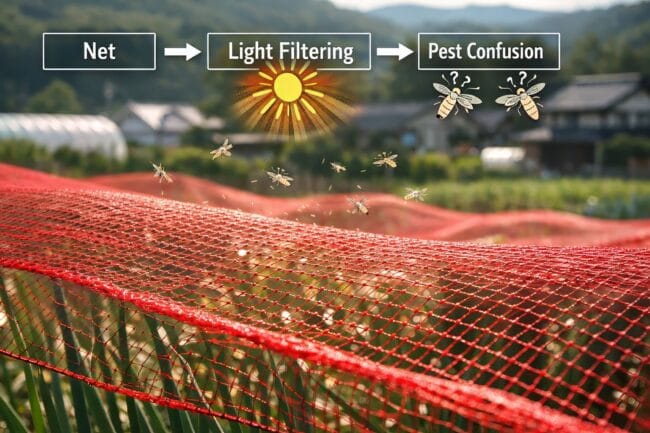
What Are Rainbow Nets and How Do They Work?
Agricultural nets are not new. Farmers have used netting for decades to physically protect crops in both greenhouses and open fields. Traditionally, nets have been white, black, or blue, and effectiveness was assumed to depend mainly on mesh size, with smaller meshes excluding smaller insects.
Recent Japanese research has challenged this assumption. Studies by the University of Tokyo and the Kyoto Prefectural Agriculture, Forestry and Fisheries Technology Center show that the color of the net itself can play a decisive role in pest control. Red-colored nets have been found to significantly deter pests like the onion thrips (Thrips tabaci), even when the mesh size is larger than the insects themselves. This innovation has led to the concept of optical pest control.
How Color Protects Crops
Most insect species, including Thrips and Whiteflies, lack red photoreceptors, meaning they do not perceive red light the same way humans do. When crops are covered with red nets, the light spectrum reaching the plants changes, creating a visual environment that confuses or deters pests.
- Visual Disorientation: Thrips struggle to identify plant leaves through the altered light, reducing their ability to feed or reproduce effectively.
- Non-lethal Control: Rainbow nets do not kill insects, preserving natural predators and pollinators while keeping harmful pests away.
- Mesh Size Flexibility: Red nets allow for larger mesh sizes without sacrificing protection, reducing material costs and improving air circulation for crops.
From Observation to Innovation
The success of red nets comes from careful observation of insect behavior and visual ecology. Farmers and researchers noticed that insects are drawn to specific light wavelengths and patterns. By manipulating these cues, rainbow nets exploit insect vision rather than relying on chemical sprays or tight mesh barriers. This demonstrates a new principle: pest exclusion can be achieved through understanding biology, not just physical constraints.
This optical method has proven especially effective for crops vulnerable to thrips and other small pests, including onions, peppers, and certain leafy vegetables. Farms implementing rainbow nets have reported significant reductions in pesticide use, highlighting their potential as a sustainable and low-chemical solution for modern agriculture.
The Invisible Wall Effect: How Rainbow Nets Create a Psychological Barrier for Pests
Much of the discussion around Rainbow Nets focuses on what insects cannot see. But the deeper story is not about blindness alone. It is about perception.
Crop pests do not wander randomly across fields. They navigate with purpose, combining chemical signals in the air with visual contrasts on the ground. The sharp edge between dark soil and green leaves acts like a landing strip. Reflections from healthy foliage guide flight paths. Color gradients signal food.
Rainbow Nets interfere with that decision making process.
Rather than forming a simple physical screen, the red mesh reshapes the light environment above a crop. Incoming sunlight shifts. Familiar contrasts fade. Plant outlines soften. To an insect scanning from above, the field no longer reads as a clear target.
Researchers increasingly describe this effect as a psychological barrier. Not because insects think in human terms, but because their instinctive rules for navigation stop working.
How Visual Contrast Guides Insect Behavior
Many agricultural pests rely on photoreceptors tuned to specific parts of the light spectrum. They detect short and mid wavelength light reflected from leaves and soil, then use those signals to orient themselves during flight.
When Rainbow Nets filter that light, the signals flatten.
Edges blur. Color separation weakens. What once looked like a promising patch of vegetation dissolves into visual background noise. The insect hesitates or veers away. Some never attempt to descend at all.
This is why red netting can reduce infestations even when the openings in the mesh are physically large enough for pests to pass through. The barrier forms long before contact.
Why This Sensory Disruption Matters for Sustainable Agriculture
Traditional pest control relies on lethality. Sprays poison insects after they arrive. Fine mesh nets stop them at the last moment.
Rainbow Nets work earlier in the chain.
By interrupting the instincts that guide approach and landing, they reduce the number of insects that ever interact with crops. Lower pressure means fewer emergency sprays. Infestations grow more slowly. Fields remain productive with less chemical intervention.
For researchers studying optical pest control, this invisible wall explains much of the dramatic pesticide reduction recorded in Japanese trials. It is not simply exclusion. It is misdirection.
And that shift has broad implications. If farmers can redesign how pests perceive fields, light and color become management tools. Agriculture moves away from escalation and toward understanding.
That is what makes Rainbow Nets more than protective fabric. They represent a new philosophy of crop defense, one that treats insect behavior itself as the frontline.
The Future: Beyond the Red Mesh
The success of Rainbow Nets in Japanese fields may represent only the first chapter of a much larger transformation in pest management.
Red wavelengths appear particularly disruptive to species such as thrips, but entomologists are already asking a broader question. If one portion of the light spectrum can interfere with insect navigation, what happens when other colors are tested against different pests.
Locusts, aphids, leafhoppers, beetles, and moths each perceive the world through distinct visual systems. Their photoreceptors respond to different bands of light. That diversity suggests agriculture could one day deploy color tuned barriers designed for specific threats rather than relying on one universal solution.
Researchers describe this emerging field as precision optical control.
Instead of blanket pesticide programs, farms might rotate net colors the way they rotate crops. One season could favor a spectrum that disrupts flying insects. Another might target ground oriented pests that rely on different visual cues. Greenhouse systems could even combine layered materials that filter multiple wavelengths simultaneously.
Rainbow Nets have opened that door.
From Field Trials to Global Research Networks
Japanese studies have sparked interest well beyond domestic agriculture ministries. Universities and agritech firms in Europe, North America, and Southeast Asia are beginning to explore similar approaches, testing how spectral filtering influences local pest populations and crop physiology.
This expansion matters. Pest pressures differ by climate zone. Cropping systems vary. What works in onion fields outside Kyoto may require modification for tomatoes in Mediterranean greenhouses or rice paddies in tropical regions.
Global collaboration could turn optical pest control into a modular toolkit rather than a single product.
Materials, Data, and Smart Farming Integration
Future versions of Rainbow Nets may also evolve in form.
Scientists are experimenting with lighter polymers, recyclable fibers, and biodegradable composites that maintain spectral properties while reducing plastic waste. At the same time, digital agriculture platforms could integrate light filtering systems with real time pest monitoring.
Cameras, traps, and AI driven models might signal when infestations rise, triggering temporary deployment of specific colored nets in vulnerable zones. Precision agriculture would meet behavioral ecology in the open field.
Why This Signals a Broader Agricultural Shift
At its core, this research challenges a century old paradigm. Crop protection has largely meant chemical escalation. The optical approach points toward environmental design instead.
Fields become engineered habitats where light, color, and structure guide insect movement. Control happens before damage occurs. Toxicity becomes a last resort rather than the first line of defense.
If that shift continues, Rainbow Nets will be remembered not only as a clever Japanese invention but as the catalyst for a new branch of agricultural science, one that treats perception as a lever for sustainability.
In that sense, the red mesh hanging above today’s crops may be only the opening color in a much broader spectrum.
Scientific Evidence: What the Research Shows
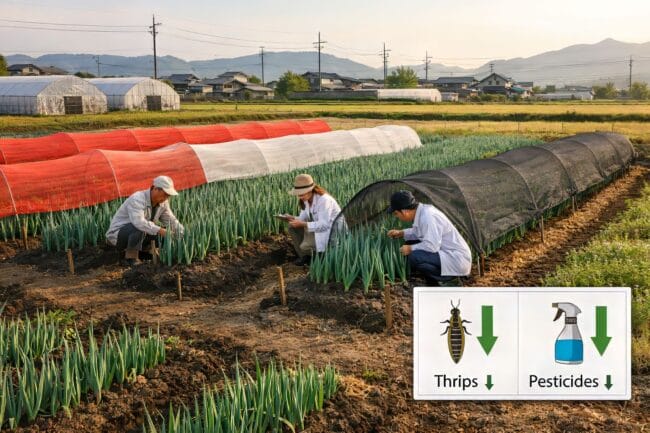
Field trials in Kyoto, Japan, have provided compelling evidence of the effectiveness of rainbow nets. Researchers tested nets of various colors, including red, white, black, and mixed combinations, against onion thrips (Thrips tabaci) feeding on Kujo leeks, a traditional Welsh onion variety cultivated in the region. The results demonstrated that net color can have a greater impact than mesh size in preventing pest damage.
Key Findings from the Trials
- Red nets outperform other colors: Plots covered with red nets had significantly fewer insects compared to white or black nets, even when the mesh size was larger than the insect body.
- Reduced pesticide use: Onion plots fully or partially covered with red nets required 25 to 50 percent fewer chemical applications than open, uncovered fields.
- High-quality yields: Fully covered areas maintained excellent crop quality and produced high-value onions with minimal pest damage.
- Effectiveness beyond mesh size: Nets with larger holes, which are normally less effective as physical barriers, still provided protection due to optical deterrence rather than physical exclusion.
The Science Behind the Results
These outcomes highlight the importance of understanding insect sensory biology. By exploiting limitations in insect vision, particularly the lack of red photoreceptors in species like Thrips, rainbow nets disrupt feeding behavior without relying on chemical sprays. This approach illustrates how integrating biological insights into pest management can enhance sustainability and reduce environmental impact.
The Kyoto trials are among the clearest demonstrations yet that optical pest control can provide measurable benefits, cutting chemical dependency while maintaining high-quality agricultural production. This evidence positions rainbow nets as a viable, low-chemical strategy for modern sustainable farming.
Comparison: Chemical Sprays vs. Rainbow Nets
For decades, chemical pesticides have served as agriculture’s frontline defense against insects. Rainbow Nets represent a fundamentally different philosophy. Instead of relying on toxicity, they reshape how pests interact with crops.
The contrast between the two approaches becomes clear when viewed across three core dimensions that matter most to farmers and regulators.
Durability in the Field
Chemical sprays offer short term protection. Rain, wind, and ultraviolet light degrade active ingredients quickly, forcing repeated applications across a single growing season.
Rainbow Nets function continuously once installed. The material remains in place for weeks or months, filtering light and discouraging pests every day without additional labor or chemical input. Over multiple seasons, that persistence changes cost calculations for growers.
Resistance and Long Term Effectiveness
One of the most serious challenges in modern agriculture is resistance. Insect populations evolve. Individuals that survive exposure to pesticides reproduce, gradually reducing the effectiveness of entire chemical classes.
Rainbow Nets operate on a different principle. They do not poison insects. They interfere with perception. Because pests are not being killed directly, there is far less selective pressure driving rapid genetic adaptation. Researchers argue that insects cannot simply learn to overcome a visual environment that removes the cues they rely on to find crops.
This makes optical pest control a potentially more stable long term strategy.
Impact on Farm Ecosystems
Broad spectrum chemicals rarely discriminate between harmful pests and beneficial species. Pollinators, predatory insects, and soil organisms can all suffer collateral damage.
Rainbow Nets avoid that problem by targeting behavior rather than biology. Bees, butterflies, and natural enemies of pests remain active in surrounding landscapes. Fields stay biologically diverse. Waterways face fewer runoff risks.
That ecological advantage is central to why regulators and sustainability advocates are paying close attention to the technology.
Why Red Nets Reduce Pesticide Use
Scientists continue to study the exact mechanisms, but evidence suggests that many insects struggle with red light because they lack photoreceptors sensitive to longer wavelengths. When crops are covered with red nets, the light reaching plants is filtered or altered, creating visual cues that confuse pests as they attempt to locate leaves.
Unlike chemical sprays, which rely on toxicity, red nets focus on behavioral modification. The nets do not kill insects directly but deter them from landing on or feeding from crops. This reduction in pest access naturally lowers the need for frequent pesticide applications, protecting both the environment and farmworkers.
Beyond Thrips: Broader Agricultural Implications
Although initial studies concentrated on onion thrips (Thrips tabaci) and Welsh onions, the implications extend to many crop systems:
- Visual cues guide many pests: Numerous insect species rely on sight to find food. Altering those visual signals can reduce pest pressure across diverse crops.
- Integration with IPM: Rainbow nets complement Integrated Pest Management (IPM) strategies that combine physical, biological, and cultural methods to minimize chemical use.
- Versatility in crop systems: Optical pest control can enhance protection in greenhouses, open-field crops, and high-value horticultural production.
Experts highlight that rainbow nets offer a new dimension in pest management, bridging conventional physical barriers with ecological approaches. By combining low-tech ingenuity with biological insight, they provide a practical solution that reduces environmental harm while maintaining crop quality.

Economic and Environmental Benefits of Rainbow Nets
Economic Advantages
Farmers who adopt rainbow nets often see a clear financial return. The nets are durable and reusable, lasting several growing seasons. This longevity spreads the initial investment over time, reducing the need for repeated purchases of chemical pesticides.
By decreasing chemical use, farms also lower costs associated with labor, equipment, and application schedules. Fewer sprays mean less time and fewer resources spent managing pests. Many growers report that crops covered with red nets achieve better quality, meeting rising consumer demand for low-residue and sustainably grown produce. This can create a competitive advantage in markets that value food safety and environmental responsibility.
Environmental Advantages
The ecological impact of rainbow nets is equally significant. Reduced reliance on pesticides means fewer chemicals leach into soil and waterways, protecting aquatic life and supporting soil health. Beneficial insects, including pollinators and natural predators, remain active, helping maintain resilient farmland ecosystems.
Lower chemical usage also translates to smaller carbon emissions, both from reduced pesticide manufacturing and decreased transport needs. The combination of financial savings and environmental protection positions rainbow nets as a practical tool for farmers seeking sustainable, low-impact solutions.
By addressing both economic and ecological challenges, rainbow nets demonstrate that simple innovations can deliver measurable benefits for farmers, consumers, and the environment.
A Practical Tool for Global Challenges
The impact of rainbow nets extends far beyond Japan. Around the world, farmers face rising challenges: pest resistance is increasing, regulations on chemical pesticide use are tightening, and consumers are demanding safer, cleaner food. Rainbow nets offer a solution that addresses these pressures simultaneously.
Aligning with Global Trends
Several global developments make the case for adopting rainbow nets:
- Regulatory pressure: Governments are implementing stricter rules to reduce pesticide use and encourage sustainable pest management practices.
- Food safety concerns: Consumers are increasingly attentive to chemical residues. Using rainbow nets can reduce pesticide exposure and build confidence in produce safety.
- Climate change effects: Shifting temperatures and altered pest migration patterns are creating unpredictable infestations, making resilient pest management tools essential.
These trends highlight the need for solutions that are low-cost, scalable, and scientifically validated. Rainbow nets fit these criteria, providing farmers with a practical tool that protects crops while reducing environmental impact and chemical dependency.
By combining simplicity with biological insight, rainbow nets demonstrate that innovative, low-tech approaches can meet global agricultural challenges without sacrificing productivity or sustainability.
Challenges and Limitations to Address
While rainbow nets provide clear advantages for reducing chemical pesticide use, several factors may limit their effectiveness and adoption.
Upfront Costs and Accessibility
High-quality red nets can cost more initially than standard netting or pesticide treatments in certain regions. Farmers with smaller plots or limited budgets may need financial support through subsidies, cooperative purchases, or microfinance programs to implement the nets successfully.
Knowledge and Training Requirements
The effectiveness of rainbow nets depends on understanding the behavior of specific pest species and proper installation techniques for different crops. Without guidance from extension services or training programs, farmers may not achieve the full potential of pesticide reduction.
Material and Environmental Considerations
Most nets are made from plastic, which raises concerns about waste. Improper disposal or lack of recycling can create agricultural plastic pollution, offsetting some of the environmental benefits. Exploring recyclable or biodegradable net options will be crucial for long-term sustainability.
Addressing these limitations will require collaboration among governments, research institutions, and farmer groups. By combining financial support, technical guidance, and sustainable materials, the benefits of rainbow nets can be extended to more farmers while protecting both crops and ecosystems.
What Experts Are Saying
Researchers view rainbow nets as a breakthrough in applying behavioral ecology to practical agriculture. By leveraging knowledge of insect visual perception, the nets offer a method to reduce crop damage without relying on broad-spectrum chemical sprays.
A member of the University of Tokyo research team explained, “This method shifts pest management from chemical toxicity to sensory deterrence, using how insects see their environment to protect crops.”
For extension specialists and agronomists, rainbow nets integrate seamlessly into Integrated Pest Management (IPM) strategies, which emphasize ecological balance and sustainable farming practices. Experts highlight that such innovations demonstrate how low-tech tools, grounded in biological science, can provide measurable environmental and economic benefits.
Looking Ahead: A Vision for Sustainable Farming
The success of rainbow nets in Japan demonstrates how incremental, science-driven innovation can address global challenges such as pesticide overuse. By applying insights from insect behavior and vision, farmers can protect crops more efficiently while reducing chemical dependence.
Future Directions
Several developments are shaping the next generation of rainbow net applications:
- Tailored designs: Nets optimized for specific pest species and crop types, informed by detailed studies of insect visual systems.
- Integration with digital tools: Combining rainbow nets with AI-driven monitoring systems to adjust coverage in real time based on pest activity and environmental conditions.
- Sustainable materials: Creating biodegradable nets that maintain optical pest control benefits while minimizing plastic waste.
These innovations highlight the potential of rainbow nets to evolve into a scalable, sustainable solution for global agriculture. By combining traditional observation, modern science, and emerging technology, rainbow nets offer a pathway toward more resilient, eco-friendly farming practices worldwide.
A Simple Solution With Big Potential
As the world searches for ways to produce food more sustainably, rainbow nets have emerged as a clear example of practical innovation. By manipulating color and light to influence insect behavior, Japanese agricultural researchers have demonstrated that crop health can be maintained while reducing pesticide use by up to 50 percent. This reduction has significant implications for farmers, consumers, and ecosystems around the globe.
Challenges remain, including initial cost, access for smallholder farmers, and the sustainability of plastic materials. Despite these hurdles, the broader lesson is evident: innovation does not always require more chemicals, high-tech equipment, or complex systems. Often, it requires a deeper understanding of natural processes and the ability to apply that knowledge in practical ways.
As global pressure grows to reduce chemical dependence and transition toward resilient, low-impact food systems, rainbow nets provide a model for how agriculture can evolve. They combine biological insight, cost-effectiveness, and environmental stewardship, showing that simple, low-tech solutions can have a profound impact on both productivity and planetary health.
By integrating these nets into broader farming practices, including Integrated Pest Management, farmers can achieve sustainable crop protection that supports ecosystems, reduces chemical exposure, and meets growing consumer demand for safe, high-quality food.
FAQ – Rainbow Nets: Japan’s Genius Way to Slash Pesticides by 50%
Q: Are rainbow nets primarily a technological innovation or an ecological strategy?
A: They are both, but their core strength lies in ecological science. By leveraging what we know about insect vision and behavior, rainbow nets reduce pest pressure without chemicals. Technology is present in their design and deployment, but the principle is rooted in biology, not machinery or chemistry.
Q: How significant is the pesticide reduction achieved by rainbow nets?
A: Field trials in Japan show that pesticide use can drop by 25 to 50 percent, depending on crop type and net coverage. This is not marginal; it represents a measurable reduction in chemical exposure for farmers, consumers, and the environment.
Q: Can rainbow nets be used for all crops and pests?
A: Not universally. Nets are most effective for pests that rely heavily on visual cues, such as thrips and whiteflies. Crop type, pest species, and local conditions must be considered, meaning tailored deployment and training are essential.
Q: Do rainbow nets replace other pest management practices?
A: They complement, rather than replace, Integrated Pest Management (IPM) strategies. By reducing pest access and chemical use, they allow farmers to integrate biological, cultural, and physical controls for more resilient and sustainable production.
Q: Are rainbow nets cost-effective for smallholder farmers?
A: Upfront costs can be higher than conventional netting or pesticides, but durability and reusability spread the investment over multiple seasons. Financial support, cooperative purchasing, or government programs can further improve accessibility for smaller farms.
Q: What about environmental trade-offs?
A: Most nets are plastic-based, so without proper recycling or disposal, they could add to agricultural plastic waste. Efforts to develop biodegradable or recyclable alternatives are underway, ensuring that the ecological benefits of reduced pesticide use are not offset.
Q: Why is Japan leading in this approach?
A: Japan’s combination of meticulous agricultural observation, research in insect sensory biology, and practical problem-solving created conditions for rainbow nets to succeed. It shows how small, low-tech interventions can have global implications when informed by science and field experience.
Editorial Disclaimer
This article, Rainbow Nets: Japan’s Genius Way to Slash Pesticides by 50%, is intended for informational and educational purposes only. The content reflects research findings, field trials, and expert commentary regarding the use of rainbow nets in sustainable agriculture. While every effort has been made to ensure accuracy, readers should note that agricultural practices can vary by region, crop type, and pest pressures.
The article does not constitute professional or legal advice. Farmers, agronomists, or other practitioners should consult local extension services, regulatory authorities, or qualified experts before implementing new pest management strategies.
The publisher and authors are not responsible for any outcomes arising from the use of rainbow nets or related practices described in this article. The goal of this content is to highlight innovations in low-chemical pest management and promote awareness of sustainable farming solutions.
References
- Red Color Agricultural Nets and Insect Behavior: A primary research article published in Scientific Reports detailing how red nets interfere with the visual perception of pests and significantly reduce crop damage via Nature.
- Innovation in Eco-Friendly Farming: The official press release and technical summary from the University of Tokyo regarding their breakthrough study on red light-selective nets via The University of Tokyo.
- Technological Impact on Pest Management: A comprehensive study available via PubMed Central exploring the physiological and behavioral responses of insects to colored netting in agricultural settings via PMC.
- Sustainability and Insecticide Reduction: Research published in the Sustainability journal analyzing the economic and environmental benefits of using colored nets as an alternative to chemical pest control via MDPI.
- Horticultural Performance of Colored Netting: An academic paper from Scientia Horticulturae investigating the impact of light-selective nets on both plant growth and pest protection via ScienceDirect.
- Integrated Pest Management Systems: An expert brief from the Graduate School of Agricultural and Life Sciences explaining the mechanism of action behind red-net technology via UTokyo Agricultural Sciences.
