

Nuclear Fusion 2026: The Race for Infinite Clean Energy
For decades, nuclear fusion existed in a narrow space between science fiction and serious physics. Researchers spoke of bottling a star. Policymakers envisioned an energy system free from carbon. Engineers, more cautious, catalogued the staggering technical barriers that stood in the way.
Today, that balance is shifting, and the moment has become known across the energy world as Nuclear Fusion 2026, a turning point defined not by promises, but by accelerating experiments, smarter control systems, and unprecedented investment.
Experimental reactors are sustaining plasmas at conditions once thought unattainable. Artificial intelligence systems are learning to anticipate instabilities before they tear superheated fuel apart. Investment is pouring into fusion startups at a pace more familiar to software booms than to heavy industry.
Fusion is no longer a distant laboratory experiment. It has become one of the most consequential technological races on the planet.
This is an ultimate guide to how it works, why the world is chasing it, who is leading the charge, and how close humanity may be to transforming the physics of stars into everyday electricity.
Nuclear Fusion 2026: The Physics Behind Fusion
Understanding Fusion in Simple Terms
Nuclear Fusion 2026 is bringing humanity closer to a future of unlimited clean energy. At its core, fusion is simple in concept but extremely challenging to achieve in practice.
Fusion occurs when two light atomic nuclei, usually hydrogen isotopes, collide with enough energy to merge into a heavier nucleus. A small amount of mass is converted into energy, following Einstein’s famous equation, E = mc². This is the same reaction that powers the Sun and all stars in the universe.
On Earth, scientists focus on fusing deuterium and tritium, producing helium and a fast-moving neutron. The neutron carries most of the released energy, which can be absorbed by surrounding materials, converted into heat, and then into electricity.
Unlike nuclear fission, which splits heavy atoms and generates long-lasting radioactive waste, fusion uses abundant fuel and produces far less persistent radioactive material. Achieving fusion requires temperatures hotter than the Sun’s core and precise control of the highly energetic plasma.
Nuclear Fusion 2026 marks a turning point in energy research. Successful fusion could provide safe, clean, and virtually limitless power for the world, reshaping how we generate and consume energy.
Why Nuclear Fusion Has Become Humanity’s Energy Obsession
Imagine a world where energy is limitless, clean, and always available. Cities buzz with electric vehicles, data centers hum day and night, desalination plants turn seawater into fresh water, and climate adaptation systems shield millions from storms and heatwaves. All of this requires vast amounts of reliable power, power that today’s energy sources struggle to provide.
The Limits of Our Current Energy
Wind turbines and solar panels are growing rapidly, yet their output depends on weather. Batteries are improving, but storing enough energy at scale is still prohibitively expensive. Nuclear fission delivers steady electricity, but it carries political controversy, regulatory roadblocks, and public anxiety that slow its expansion. Humanity’s energy future feels fragile, uncertain, and constrained.
Why Fusion Is Different
Enter Nuclear Fusion 2026. Unlike anything before, fusion promises carbon-free energy from fuels found in seawater and lithium. There is no risk of catastrophic chain reactions, and radioactive waste fades in decades rather than millennia. This is not theoretical. Recent breakthroughs are turning science fiction into engineering reality. Laboratory plasmas now release as much energy as they consume. Laser-driven experiments reach ignition conditions once considered impossible. Magnetic confinement devices sustain plasma longer than ever. AI systems predict disruptions before they occur, and superconducting magnets generate fields stronger than ever imagined.
The Global Race for Limitless Energy
Fusion has become more than a scientific challenge. It is a global race. Governments see energy security. Investors envision a trillion-dollar market. Scientists witness the culmination of a century-long quest for clean, limitless power. Every experiment, every breakthrough, shifts momentum closer to a world where energy scarcity is history.
Nuclear Fusion 2026 is not just an idea. It is the path toward a future where cities, industries, and societies can grow without limits, powered by safe, clean, and virtually infinite energy. This is humanity’s obsession, and the race is on.
Recent Breakthroughs That Shifted Momentum
For decades, nuclear fusion felt like a dream on the distant horizon. Progress was measured in tiny increments, with slightly higher temperatures, marginally longer confinement times, and incremental improvements in plasma stability. Each success was slow, careful, and painstaking.
Laboratory Plasmas Finally Hit Their Stride
Everything changed when a series of experiments shattered symbolic barriers. For the first time, laboratory plasmas briefly released as much energy as was pumped in to heat them. Laser-driven experiments achieved ignition regimes that scientists once thought impossible. Magnetic confinement devices sustained plasma longer than ever, reaching conditions that edge closer to real-world reactors.
Technology and AI Supercharge the Race
Breakthroughs did not stop at the plasma. High-temperature superconducting magnets now generate stronger magnetic fields within smaller, more practical devices. Meanwhile, machine learning systems can predict plasma disruptions before they happen, giving engineers unprecedented control over these volatile reactions.
Fusion Becomes Realistic, Not Theoretical
Taken together, these results did not solve fusion overnight. But they sent a clear message: this is no longer a purely theoretical challenge. Nuclear Fusion 2026 is now an engineering race, attracting policymakers, investors, and scientists who see the promise of clean, limitless energy within reach. The momentum has shifted, and the world is starting to believe fusion is finally possible.

Magnetic Confinement: The Tokamak Design and Its Promise
Fusion energy’s most promising path today is the tokamak, a doughnut-shaped chamber where plasma is held aloft by magnetic fields, looping endlessly without touching material walls. It is a structure that looks simple at first glance, but hides some of the most complex physics humanity has ever attempted to control.
How Tokamaks Work
Inside the tokamak, electric currents flow through the plasma, generating self-stabilizing magnetic fields. Surrounding superconducting coils add extra confinement, keeping the plasma suspended and controlled. The challenge is immense. The plasma must remain incredibly hot, extremely dense, and remarkably stable long enough for fusion reactions to produce more energy than they lose. Every millisecond counts, and every fluctuation must be managed with precision.
Why Tokamaks Are Pivotal
Decades of investment from international collaborations and national laboratories have refined tokamak design to near perfection. These devices scale well, can theoretically operate continuously, and integrate seamlessly into power plant concepts, where heat is captured by surrounding blankets and converted into electricity.
Tokamaks are not cheap, and they are far from simple. Yet they represent the clearest bridge from today’s experimental reactors to Nuclear Fusion 2026–enabled, grid-connected fusion power. Each breakthrough in confinement, temperature control, and material science pushes humanity closer to realizing the dream of clean, virtually limitless energy.
Extreme Temperatures and Plasma Control
Step inside a fusion reactor, and you are closer to the sun than anywhere else on Earth. Temperatures soar beyond one hundred million degrees Celsius, a heat so extreme it turns matter into a storm of charged particles. The plasma seethes, writhes, and constantly threatens to escape its invisible magnetic cage. One miscalculation, one ripple, and energetic particles slam into the reactor walls, erasing months of work in an instant.
Taming the Wild Plasma
Physicists watch the chaos like conductors of a fiery orchestra. Supercomputers churn out predictions, but the plasma never follows the script perfectly. Sensors monitor millions of points, tracking temperature spikes, density shifts, and turbulent eddies that appear and vanish in milliseconds. Control systems respond faster than human reflexes, nudging the plasma back into line with precise magnetic pushes. Every second feels like walking a tightrope over molten stars.
The Ultimate Test of Skill and Science
This is not just science. It is a battle against nature itself. Controlling fusion plasma demands mastery over fluid dynamics, electromagnetism, nuclear physics, and materials science simultaneously. There is no margin for error. Yet with every stable pulse, every microsecond of control, humanity edges closer to Nuclear Fusion 2026, a world where clean, virtually limitless energy is no longer a dream but a tangible, breathtaking reality.
The thrill is palpable. Engineers and physicists lean over consoles, eyes scanning readouts, hearts racing as glowing plasma dances inside the tokamak. Each tiny success is a victory over one of the universe’s most extreme forces, and every experiment writes a new chapter in the story of energy’s future.
Artificial Intelligence in Fusion Control
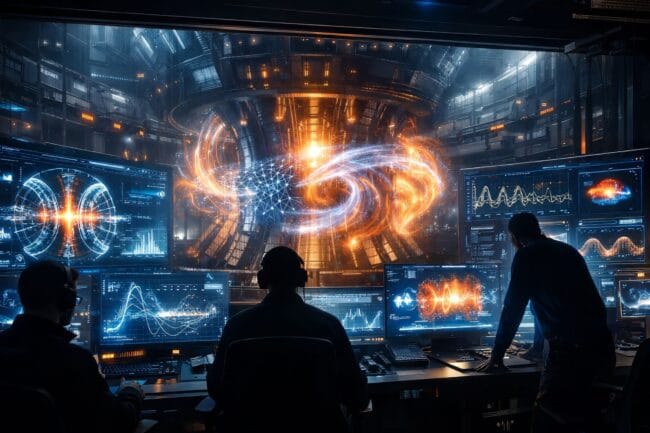
Step into the control room of a fusion reactor, and the scene is almost cinematic. Screens flicker with streams of data, graphs pulse in real time, and the hum of superconducting magnets fills the air. Here, artificial intelligence has become a partner in one of the most extreme experiments on Earth.
Predicting Chaos Before It Strikes
Plasma can shift violently in a fraction of a second. One unexpected spike can destabilize the reactor. Machine learning systems continuously analyze torrents of diagnostic data, spotting dangerous instabilities before they can erupt. Some algorithms have digested decades of archived experiments, uncovering subtle patterns that human operators could easily miss.
Digital Twins: Virtual Testbeds for the Impossible
Digital twins, virtual replicas of the reactor running on supercomputers, allow engineers to simulate countless scenarios. Every magnetic tweak and every design adjustment is tested in these high-fidelity models before touching real hardware. It is like rehearsing a high-wire act in a digital world, where mistakes are lessons, not disasters.
AI as the Conductor of a Plasma Orchestra
Artificial intelligence does not replace the physicists. It magnifies them. Engineers and plasma experts work side by side with AI, orchestrating the behavior of a seething, million-degree plasma storm. In a field where milliseconds matter, AI’s predictions and adjustments can be just as decisive as the magnets and lasers themselves. Every successful maneuver is a victory, bringing Nuclear Fusion 2026 one step closer to the dream of stable, clean, and virtually limitless energy.
Materials That Must Survive Fusion Conditions
Inside a fusion reactor, the environment is unforgiving. Even without touching the plasma, the reactor walls endure assaults hotter and more violent than anything on Earth. High-energy neutrons slam into structures, knocking atoms out of place and slowly wearing metals down. Intense heat, repeated stress cycles, and relentless radiation would destroy ordinary materials in a matter of weeks.
Engineering the Impossible
Scientists and engineers are racing to create materials that can survive where nothing else would. Advanced steels are alloyed for extraordinary strength. Tungsten composites resist extreme heat. Ceramic-based materials endure radiation that would crumble conventional metals. Liquid metal walls flow continuously to absorb energy and repair themselves. Self-healing structures are being designed to patch microscopic damage before it becomes catastrophic. Each innovation is a step toward a machine that can withstand the fury of the plasma it contains.
The Tritium Puzzle
The materials challenge does not end at survival. Inside the reactor, lithium-containing blankets must breed tritium fuel to sustain a closed-cycle fusion reaction. These blankets face the dual threat of extreme heat and radiation while performing a critical function. The stakes are high: without these materials, even perfect plasma confinement would fail to deliver practical energy.
Every breakthrough in metallurgy, composite design, and manufacturing brings Nuclear Fusion 2026 closer to reality. The dream of clean, virtually limitless energy depends not just on taming plasma, but on building a reactor capable of surviving and thriving in conditions more extreme than the heart of a star.
Private Fusion Startups and Billion-Dollar Bets
What was once the exclusive playground of governments is now a magnet for private capital. The race for fusion energy has gone commercial, and the stakes could not be higher.
A New Breed of Energy Entrepreneurs
Dozens of startups are challenging decades of conventional thinking. They are building compact tokamaks, experimenting with magnetized target fusion, and exploring entirely new fuel cycles. High-profile technology leaders and venture funds have poured billions into these ventures, betting that a breakthrough could redefine the global energy landscape.
Speed, Agility, and the Startup Advantage
Unlike sprawling government megaprojects, startups promise rapid iteration. They leverage advanced manufacturing, simulation-driven design, and small, agile engineering teams that can pivot faster than any traditional lab. Every experiment and every prototype is a gamble, but each step could leapfrog years of traditional research. Critics warn that fusion is too complex for startup timelines. Supporters counter that competition accelerates innovation, turning bold bets into tangible progress.
The Hybrid Ecosystem of Fusion Innovation
The fusion frontier is now a patchwork of national labs, international collaborations, and private firms, all pushing the limits in parallel. Sometimes they cooperate, sometimes they race. The result is a dynamic ecosystem where breakthroughs in one corner of the world ripple instantly across the industry, fueling excitement, competition, and the tantalizing promise of Nuclear Fusion 2026, a world powered by clean, virtually limitless energy.

How Safe Is Fusion Compared to Fission
Public fear of nuclear energy runs deep. Images of melted-down fission reactors and the shadow of nuclear weapons linger in collective memory. Stepping into a fusion reactor control room, however, tells a very different story.
Safety Designed Into the Core
In a fusion reactor, danger is contained by physics itself. The fuel inside the reactor is measured in grams, tiny compared to the tons used in fission plants. There is no chain reaction that could spiral out of control. If anything goes wrong, the plasma cools instantly, and the reaction stops naturally. Unlike fission, the nightmare of a catastrophic meltdown simply cannot happen.
Radiation Without the Horror
Fusion does produce radiation, primarily from fast neutrons, and reactor components become activated over time. Yet the resulting waste is far smaller in volume and decays far faster than spent fission fuel. Handling it is far simpler, and the environmental risk is minimal. It is a quiet, manageable radiation footprint compared to the decades-long hazard of fission.
Reassuring Communities and Regulators
Even with these intrinsic advantages, fusion will still require careful regulation, licensing, and community engagement. But from a physics standpoint, it starts from a baseline of safety unimaginable in fission. Every successful pulse, every controlled plasma moment, moves humanity closer to Nuclear Fusion 2026, a future powered by clean, virtually limitless energy, with risk contained at the atomic level.
The Economics of Fusion Energy and Long-Term Market Impacts
The first generation of fusion power plants will not come cheap. Massive superconducting magnets hum with controlled fury, exotic materials line every wall, and complex cooling and maintenance systems are designed to withstand conditions hotter than the sun. The price tag is enormous, but the prize could be even greater: a world powered by clean, virtually limitless energy.
Betting on Scale and Ingenuity
The future of fusion economics relies on learning fast and scaling smarter. Standardized reactors, mass-produced components, and continuous operation could dramatically drive down costs, just as solar panels and wind turbines became affordable over time. Each experiment, every prototype, and every engineering adjustment adds to a library of knowledge, shortening the path to profitability. In this high-stakes race, speed and innovation are as valuable as capital itself.
Transforming Industries and Lives
Abundant electricity could reshape the global economy. Water-stressed regions might turn to large-scale desalination. Hydrogen and synthetic fuels could compete without subsidies. Heavy industry could decarbonize at last, while high-tech manufacturing and computing expand without energy limits. Fusion is not just another energy source. It is the engine for an economic revolution.
A New Geopolitical Landscape
Fusion energy could also redefine global power. Nations rich in technical expertise rather than fossil fuels may emerge as leaders. Energy security strategies would be rewritten, international alliances recalibrated, and the calculus of national influence transformed. Nuclear Fusion 2026 promises more than just electricity. It promises a world where clean energy shapes politics, prosperity, and progress.
Timeline Expectations and When Fusion Might Reach the Grid
Everyone wants to know the same thing: when will fusion finally power our world? For decades, the answer seemed always just out of reach. Each decade brought breakthroughs, yet commercialization remained perpetually one experiment away. Fusion has long been a horizon that retreats as we approach it.
A Turning Point in Progress
Now, the tone is cautiously optimistic. Pilot plants are being designed to generate sustained power, demonstrating that fusion is more than a lab curiosity. Supply chains for superconducting magnets and specialized materials are being built. Regulators are drafting rules tailored for fusion, moving beyond the borrowed frameworks of fission. The gears of an entirely new energy industry are slowly starting to turn.
The Long, Steep Path
Most experts still measure timelines in decades rather than years. Early grid-connected demonstrations may appear soon, but scaling these systems to meet global energy demand will take persistent effort. The challenges are immense, from plasma stability to material endurance. Yet every pulse, every successful test, brings humanity closer to a world powered by clean, virtually limitless energy.
Fusion as an Emerging Industry
For the first time, fusion is discussed not just as a scientific marvel but as an emerging industry with real economic and geopolitical stakes. Investors, engineers, and governments are aligned behind a shared vision: Nuclear Fusion 2026 is no longer just a dream. It is the blueprint for the future, where the planet’s energy needs meet human ingenuity, and the promise of fusion finally inches toward reality.
The Grand Significance of Nuclear Fusion
Nuclear fusion sits at the crossroads of physics, climate urgency, geopolitical strategy, and technological ambition. It demands machines hotter than the core of the sun, materials tougher than anything ever deployed in power plants, and control systems faster and smarter than human reflexes. Every pulse of plasma is a battle against nature itself, a demonstration that humanity can bend the laws of the universe toward practical purpose.
This is a challenge unlike any other. Engineers and physicists are pushing the limits of what is possible, designing superconducting magnets that generate fields stronger than the most powerful natural forces on Earth, and creating materials that can survive a relentless barrage of high-energy neutrons and extreme heat. Every breakthrough represents not just a technical achievement but a glimpse of a future where energy scarcity could become a problem of the past.
Whether fusion ultimately revolutionizes the global energy system or finds a specialized role in industry, the race itself is already reshaping how humanity thinks about powering the world. Energy strategy, industrial planning, and geopolitical influence are all being reimagined through the lens of this one technology. What once seemed like distant science fiction has transformed into one of the most serious, high-stakes engineering projects of our era.
For the first time, the conversation is no longer “if” but “when.” Each experiment, each pilot plant, and each incremental advance brings Nuclear Fusion 2026 closer to reality, a world where clean, virtually limitless energy could transform economies, secure energy independence, and dramatically reduce humanity’s impact on the planet. The promise of fusion is not just electricity, it is a new way of thinking about what is possible, a benchmark for human ingenuity, and a symbol of ambition unbound by current limitations.
FAQ – Nuclear Fusion 2026
Understanding Nuclear Fusion can seem complex. These frequently asked questions provide clear answers, context, and insight into the technology, recent breakthroughs, and potential energy applications, all in a simple, easy-to-read format.
Q: What is Nuclear Fusion?
A: Nuclear fusion is the process of combining light atomic nuclei, such as hydrogen isotopes, into heavier nuclei. This releases enormous amounts of energy, similar to the reactions powering the Sun. Fusion produces minimal radioactive waste and has the potential to provide clean, virtually limitless energy.
Q: How is fusion different from nuclear fission?
A: Unlike fission, which splits heavy atoms and can create long-lived radioactive waste, fusion combines light atoms and cannot run out of control. If systems fail, the plasma simply cools, and the reaction stops. Fusion starts from a safer baseline while producing energy comparable to fission.
Q: When could fusion energy reach the power grid?
A: Experts expect pilot plants to demonstrate sustained energy in the coming decades, with broader deployment following if those systems perform as planned. Fusion is still a technical challenge, but it is transitioning from theory to emerging industry.
Q: What are the main challenges of fusion?
A: Fusion requires extreme conditions, including plasma hotter than the Sun, advanced materials, and precise magnetic confinement. Maintaining stability and handling neutron radiation are some of the toughest engineering hurdles. Artificial intelligence and new materials help make control and longevity possible.
Q: How could fusion impact the global economy?
A: If successful, fusion could provide abundant, cheap electricity. This would allow large-scale desalination, decarbonization of industry, and the growth of hydrogen and synthetic fuels. Nations with technical expertise could gain geopolitical advantage, reshaping global energy markets.
Editorial Disclaimer
This article, Nuclear Fusion 2026: The Race for Infinite Clean Energy, is created for educational and informational purposes only. The field of nuclear fusion is advancing rapidly, and details about reactor technologies, energy timelines, and breakthroughs may change as research progresses.
The information presented here does not constitute professional, financial, or investment advice. Any references to pilot plants, fusion timelines, or emerging technologies are based on current scientific understanding and publicly available sources. Readers should verify details and consult qualified experts before making decisions based on this content.
The goal of this article is to provide a clear and balanced view of the scientific, technological, economic, and strategic aspects of nuclear fusion. The opinions and interpretations presented reflect the editorial team’s perspective and do not represent the positions of any specific laboratory, company, or government organization involved in fusion research.
By reading Nuclear Fusion 2026: The Race for Infinite Clean Energy, you acknowledge that nuclear fusion is a complex and evolving field, and that projections or expectations discussed here may shift as new discoveries and engineering advancements emerge.
References
- IAEA World Fusion Outlook 2025: The latest authoritative report from the International Atomic Energy Agency providing a global overview of fusion energy research, technology trends, and commercialization timelines via IAEA.
- Strategic Roadmap for Fusion Power: A comprehensive technical analysis from the National Academies of Sciences, Engineering, and Medicine on the development of a pilot plant and the future of fusion energy via National Academies.
- Fusion Engineering and Design Journal: A leading peer-reviewed academic journal focused on the practical and technical aspects of fusion energy systems and experimental reactors via ScienceDirect.
- ITER Worldwide Fusion Research Network: Official documentation and technical links from the world’s largest international fusion experiment, connecting major global research institutions via ITER.
- Plasma Physics and Controlled Fusion: A high-impact academic journal publishing original research on all aspects of plasma physics and controlled nuclear fusion via IOPscience.
- Nuclear Fusion Power Information Library: An in-depth technical resource from the World Nuclear Association detailing the physics, fuel cycles, and challenges of commercial fusion power via World Nuclear Association.
