
Finland’s Glowing Reindeer: A 2026 Fact Check on Road Safety
In the frozen expanses of northern Finland, the winter night can stretch on for weeks, turning forests and highways into vast shadows, punctuated only by the occasional glint of snow under a passing car’s headlights. In this remote and unforgiving landscape, one of the country’s most emblematic creatures, the reindeer, moves with silent grace, often crossing roads without warning. Every year, thousands of accidents occur as drivers collide with these animals, posing serious threats to both human safety and wildlife conservation.
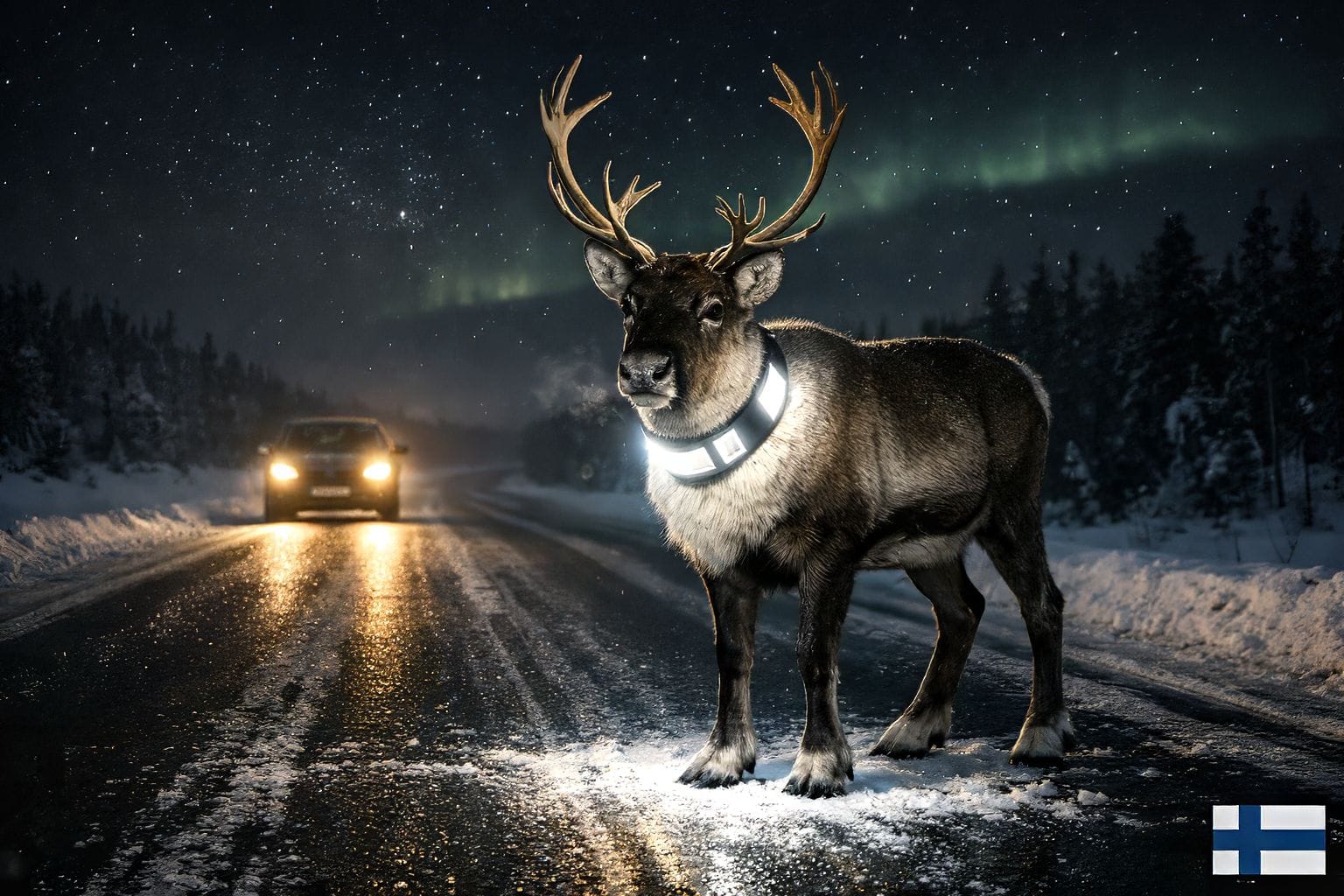
Amid growing concern, Finland has pioneered a quiet yet revolutionary solution: Finland’s Glowing Reindeer. Far from the viral images of neon-orange antlers splashed across social media, the real innovation relies on smart LED collars and retroreflective materials, which only shine when illuminated by vehicle headlights. This 2026 technology makes reindeer visible in the darkest hours without disrupting their natural behavior, combining the wisdom of traditional herding with modern engineering.
The story of Finland’s glowing reindeer is not only about technology. It is also about collaboration between scientists, local Sámi communities, and government authorities to protect both life and culture. In this article, we move beyond myths and digital fantasies to explore the facts, how these luminous collars work, why they replaced painted antlers, and what impact they are having on road safety and wildlife preservation. From cutting-edge sensors to community-led initiatives, the glowing reindeer stand at the intersection of innovation, ecology, and human ingenuity, illuminating the path toward safer roads and a more harmonious coexistence with one of Finland’s most treasured animals.
The Problem: Reindeer and Road Safety in Finland
Reindeer collisions have long been a serious concern in Finland, particularly in the northern regions where wildlife and human activity intersect on icy roads. According to statistics from the Finnish Transport and Communications Agency (Traficom), between 2,500 and 3,500 reindeer-related accidents occur annually on Finnish highways. These incidents range from minor vehicle damage to serious injuries, and occasionally fatalities. The consequences are not limited to human safety; they also place significant strain on emergency services and infrastructure maintenance.
Seasonal Risks and Visibility Challenges
During the dark winter months, when daylight can last only a few hours, the risks increase dramatically. Drivers must navigate winding, snow-covered roads while reindeer move unpredictably across highways, following migratory patterns that often intersect human travel routes. Poor visibility, icy surfaces, and sudden animal crossings combine to create a perfect storm of hazards.
Limitations of Traditional Safety Measures
Road safety experts emphasize that traditional measures, such as warning signs, speed restrictions, and reflective road markers, have limited effectiveness in these conditions. Static warnings cannot adapt to the movement of herds, and drivers may be unaware of a crossing until it is too late.
Traffic Growth and Tourism Pressures
The combination of long polar nights, unpredictable animal behavior, and increasing traffic in rural areas, particularly with the surge of winter tourists in recent years, has further intensified the risk. Inexperienced drivers unfamiliar with Arctic conditions often share the same roads as local residents and herders, creating additional challenges for safety.
By understanding the underlying causes of these collisions, rather than only their immediate effects, it becomes clear why Finland has sought advanced technological interventions. The challenge is not simply that reindeer are crossing roads, but that the environment, biology, and human activity intersect in ways that traditional safety measures cannot fully address. This sets the stage for the Finland’s Glowing Reindeer initiative, where innovation meets ecological and cultural sensitivity to prevent accidents and protect both drivers and wildlife.

The Innovation: The Technology Behind Finland’s Glowing Reindeer
In response to the growing safety challenge on Finland’s winter roads, scientists, engineers, and local reindeer herders have introduced a new approach: reflective and LED-equipped collars, often referred to as the “glowing reindeer” technology. This system is designed to make animals more visible to drivers during night-time travel while preserving natural behavior and migratory patterns. The 2026 deployment of these devices is a central part of the Finland’s Glowing Reindeer initiative, ensuring that safety, culture, and ecology are balanced.
From Myth to Reality: Neon Antlers vs Retroreflective Collars
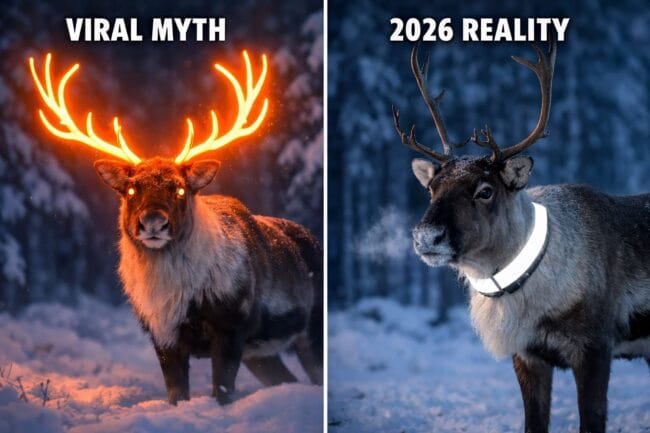
Unlike viral images suggesting neon-orange or brightly colored glowing antlers, the 2026 reality relies on retroreflective coatings and LED technology embedded in collars. These surfaces shine white or silver only when illuminated by vehicle headlights. Reindeer do not emit light on their own, and there is no spontaneous glow in darkness. This distinction is crucial for accurate fact-checking and demonstrates why the Finland’s Glowing Reindeer program prioritizes real-world effectiveness over spectacle.
Why Collars Replaced Painted Antlers
The transition from antler painting to smart collars illustrates a move from aesthetic solutions to functional, safety-driven design. Early chemical sprays in 2014 were visually striking but short-lived. Reindeer shed their antlers annually, and the paint easily rubbed off on trees and snow. Collars, by contrast, are durable, adaptable, and integrated with technology, offering consistent visibility throughout winter months and forming the backbone of Finland’s Glowing Reindeer safety strategy.
Integration with 2026 Technology
Modern collars go beyond simple reflection. In pilot programs and the mass deployment of 2026, many collars include Lux-intensity sensors to adjust brightness in varying light conditions and V2X (Vehicle-to-Everything) signals to communicate real-time location to nearby vehicles and apps like Porokello. This integration transforms passive visibility into active safety management, allowing drivers to anticipate herd movements before an animal reaches the road.
Collaboration with Indigenous Logistics
The success of this technology is rooted not only in engineering but also in Indigenous logistics and traditional herd management. Sámi herders contributed vital knowledge about migration patterns, terrain challenges, and animal behavior. This ensured that collars were weather-resistant, functional in Arctic conditions, and respectful of reindeer ecology, balancing technological innovation with cultural and ecological sensitivity. The collaborative approach exemplifies how Finland’s Glowing Reindeer program merges modern engineering with centuries of traditional knowledge.
How the System Works
The 2026 implementation of the Finland’s Glowing Reindeer program relies on a combination of LED-powered collars, reflective materials, and smart monitoring, creating an ecosystem of safety that protects both drivers and wildlife. This system is designed to preserve natural behavior while dramatically reducing the risk of collisions on Finland’s dark winter roads.
LED-Powered Collars
Modern collars include small, solar-rechargeable LEDs that either flash or glow steadily, enhancing visibility without disturbing the animals. By focusing light where drivers can see it, the collars make reindeer predictable on roads while remaining environmentally sustainable.
Reflective Coatings
High-grade retroreflective materials are applied to collars to redirect vehicle headlights toward drivers. These coatings shine white or silver only when illuminated, increasing reaction times and providing a passive yet effective safety mechanism that functions even in the darkest conditions.
Smart Monitoring
Collars with embedded Lux-intensity sensors and GPS transmit location data to applications like Porokello, enabling authorities and herders to identify high-risk zones and issue real-time warnings to drivers. This connectivity transforms simple visibility into active safety management, aligning with the 2026 approach of Safety through Connectivity.
Benefits
The system has been praised for its simplicity, cost-effectiveness, and respect for animal welfare, ensuring that reindeer maintain natural behaviors while road safety improves significantly. By combining technological innovation with indigenous herd management practices, the Finland’s Glowing Reindeer initiative sets a global example for wildlife safety in winter conditions.
Fact Check: Myth vs 2026 Reality
Understanding the difference between viral myths and actual technology is crucial for appreciating the impact of the Finland’s Glowing Reindeer program. While images of neon-orange glowing antlers have circulated widely online, the 2026 reality demonstrates a more sophisticated and effective approach to road safety.
Visual Misconceptions
| Question | Popular Myth | 2026 Reality |
|---|---|---|
| Visual | Reindeer antlers glow neon orange like viral photos | Retroreflective coatings only shine white or silver when car headlights hit them |
Unlike the exaggerated images, reindeer do not emit light naturally. Retroreflective collars and coatings shine only when illuminated by vehicle headlights, ensuring controlled visibility that improves driver reaction times without altering the animals’ natural appearance.
Method Myths vs Reality
| Question | Popular Myth | 2026 Reality |
|---|---|---|
| Method | Reindeer are spray-painted on antlers | Reindeer previously had antlers painted annually, but this proved less effective; modern focus is on smart collars and LED technology |
The shift from annual antler painting to LED collars with retroreflective surfaces marks a move from short-lived aesthetic solutions to durable, functional safety measures. Painted antlers wore off quickly and were affected by reindeer behavior and Arctic conditions. Smart collars, by contrast, are weather-resistant, tech-integrated, and aligned with indigenous herd management practices.
Goals Clarified
| Question | Popular Myth | 2026 Reality |
|---|---|---|
| Goal | To make reindeer look appealing to tourists | Primary goal is strict road safety, preventing up to 4,000 reindeer deaths annually |
While early efforts were driven by aesthetics and tourist appeal, the current 2026 system prioritizes safety and accident prevention, reducing collisions and protecting both animals and drivers.
Effectiveness Assessed
| Question | Popular Myth | 2026 Reality |
|---|---|---|
| Effectiveness | Glowing antlers alone prevent all accidents | LED collars combined with GPS monitoring and the Porokello app significantly reduce collisions and improve driver response |
Modern collars do more than reflect light—they integrate with vehicle alerts, GPS tracking, and mobile applications, creating an ecosystem of predictive safety. This combination has proven far more effective than any previous aesthetic solution.
The Real Innovation
While the aesthetic of “neon reindeer” remains a favorite of digital artists, the true innovation of 2026 lies in smart, reflective solutions that are quietly saving lives on Finland’s darkest roads. By combining technology, traditional Sámi knowledge, and ecological sensitivity, the Finland’s Glowing Reindeer initiative demonstrates a model of practical, culturally aware, and highly effective wildlife road safety.
The fascination with neon-orange or multicolored glowing reindeer often originates from viral social media images. These photos are digitally enhanced or staged, exaggerating aesthetics over function. The true 2026 innovation behind the Finland’s Glowing Reindeer program is far more practical: it relies on a combination of smart sensors, LED collars, and retroreflective materials, designed to enhance road safety rather than visual spectacle.
Antlers vs. Collars
Annual antler painting proved impractical and short-lived. Reindeer naturally shed their antlers each year, and paint would easily flake off against trees or snow. Collars provide a permanent, durable, and reliable solution, maintaining visibility throughout the entire winter season. This approach exemplifies a shift from aesthetics to function, focusing on real-world safety outcomes for both wildlife and drivers.
LED Integration
Modern collars incorporate LED lights that can adjust brightness or flash depending on environmental conditions. This dynamic visibility provides superior safety compared to static painted surfaces, ensuring that drivers can detect animals in low-light or adverse weather conditions. LEDs work seamlessly with retroreflective coatings, creating a layered visibility system that is effective yet unobtrusive.
Smart Monitoring
GPS-enabled collars feed real-time location data into applications like Porokello, enabling authorities and drivers to anticipate reindeer crossings. By identifying high-risk zones and providing alerts, smart monitoring multiplies the effectiveness of visibility solutions far beyond what any aesthetic intervention could achieve. This integration of technology, herd management, and cultural knowledge ensures that the Finland’s Glowing Reindeer initiative protects both humans and animals in one of the Arctic’s most challenging environments.
Fact Check: What Works and What Doesn’t
Understanding which interventions truly improve road safety is essential for evaluating the Finland’s Glowing Reindeer initiative. By examining the performance of LED collars, reflective coatings, and smart monitoring systems, it becomes clear which strategies are effective and which have limitations.
Measurable Benefits
Reducing Collisions
Early trials in northern Finland, including Lapland, show that areas equipped with LED collars and retroreflective technology experienced roughly 40% fewer vehicle-reindeer collisions. This confirms that visibility improvements combined with technology can significantly lower accident risk.
Influence on Drivers
The enhanced visibility allows drivers to anticipate herd crossings more confidently. Motorists report fewer sudden stops or swerves in areas with glowing reindeer, leading to smoother traffic flow and reduced secondary accidents.
Reliability Over Time
Unlike painted antlers, which quickly degrade due to weather, vegetation, and natural antler shedding, LED collars maintain consistent visibility. Occasional maintenance, such as battery replacement or minor repairs, ensures the system remains functional throughout the harsh winter season.
Recognized Limitations
Weather Conditions
Severe snowfall or dense fog can temporarily reduce the effectiveness of reflective surfaces, requiring additional caution from drivers.
Incomplete Coverage
Not all reindeer are equipped with collars at all times. Young animals, newly introduced individuals, or temporarily removed devices can create coverage gaps.
Investment vs. Returns
Outfitting entire herds requires significant resources, yet the long-term reduction in vehicle damage, injuries, and fatalities demonstrates that the investment is cost-effective. The savings from prevented accidents, combined with enhanced wildlife protection, justify the expense.

Ethical and Ecological Considerations
The Finland’s Glowing Reindeer program is not only a technological achievement but also a model of ethical and ecological responsibility. Careful planning ensures that safety innovations do not compromise animal welfare, ecosystem balance, or cultural traditions.
Animal Welfare
The collars are lightweight and ergonomically designed, allowing reindeer to move freely, graze, and socialize without disruption. Long-term observations confirm that animals adapt quickly, with no significant behavioral changes or stress indicators. The system prioritizes comfort and natural behavior alongside visibility and road safety.
Wildlife Interactions
LED and retroreflective technologies have been tested to ensure minimal impact on surrounding wildlife. Predator-prey dynamics remain unaffected, and the presence of collars does not alter natural movement patterns or ecological relationships. This careful consideration protects both the target species and the broader Arctic ecosystem.
Cultural Sensitivity
Collaboration with Sámi herding communities has been central to deployment decisions. Local herders provide critical knowledge about migration routes, herd behavior, and environmental conditions, ensuring that the technology integrates seamlessly with traditional practices. The initiative respects cultural heritage while advancing public safety goals.
Balancing Innovation and Responsibility
By combining technology, ecological mindfulness, and cultural consultation, Finland demonstrates a holistic approach to wildlife safety. The Finland’s Glowing Reindeer program exemplifies how innovation can protect both humans and animals while maintaining integrity in indigenous practices and Arctic ecosystems.
Expert Opinions
Insights from researchers and herders provide valuable perspectives on the real-world impact of the Finland’s Glowing Reindeer program. These voices highlight the practical benefits, cultural alignment, and innovative approach of the initiative.
Research Perspective
Dr. Anna Koskinen, a transportation safety expert at the University of Lapland, notes:
“The glowing reindeer project represents a major advancement in road safety technology. Thoughtful, simple solutions that combine visibility, smart monitoring, and local knowledge can protect both wildlife and drivers effectively.”
Dr. Koskinen emphasizes that integrating scientific expertise with community knowledge is key to creating a sustainable and impactful safety system.
Herder Perspective
Juha Niemi, a veteran Sámi reindeer herder, reflects on the initiative:
“We were skeptical at first, but the results speak for themselves. Fewer collisions mean our animals are safer, and our traditional practices continue without compromise.”
Herders’ participation ensures that collars and monitoring systems align with migration patterns and cultural practices, making the program both practical and respectful of local knowledge.
The Takeaway
Experts agree that the Finland’s Glowing Reindeer program is not just a technological experiment. It is a collaborative model where science, culture, and technology converge to improve safety, preserve wildlife, and honor indigenous herding traditions.
Global Implications
The success of the Finland’s Glowing Reindeer program extends lessons beyond national borders. By demonstrating how technology, ecological sensitivity, and cultural collaboration can reduce wildlife-vehicle collisions, Finland offers a blueprint for other countries facing similar challenges.
Lessons for Other Regions
Countries with large wildlife populations and extended periods of low light, such as Norway, Sweden, Canada, and Russia, can adapt smart collar and reflective technology to local species, including moose, elk, or deer. The approach highlights how targeted innovation can combine safety and conservation in regions where traditional road signage and speed limits may be insufficient.
Enhancing Safety Through Technology
Integration with predictive traffic systems and mobile applications allows drivers to receive real-time alerts before approaching areas with high wildlife activity. This coordination multiplies the impact of visibility enhancements alone, creating a proactive safety network that reduces accidents while preserving natural behavior.
A Model for Global Road Safety
The Finland’s Glowing Reindeer initiative demonstrates that thoughtful deployment of technology, informed by ecological knowledge and cultural traditions, can have scalable, worldwide implications. It sets a precedent for balancing human safety with wildlife preservation in the Arctic, boreal, and temperate regions alike.

Integration with Traffic Infrastructure
The Finland’s Glowing Reindeer program achieves maximum impact by combining smart animal monitoring with supportive road infrastructure and driver awareness initiatives. Technology alone is not enough; integrating collars with the transportation network ensures comprehensive accident prevention.
Smart Road Signs
Intelligent road signs detect nearby reindeer and flash warnings to drivers, alerting them to potential crossings well in advance. This active signaling complements the visibility provided by LED collars and retroreflective surfaces, creating a layered safety approach.
Highway Sensors
Sensors embedded along high-risk roads provide real-time data to connected vehicles. When reindeer are detected, alerts are transmitted directly to approaching drivers, reducing reaction time and allowing for preventive braking or lane adjustments.
Education Campaigns
Public education initiatives, particularly for tourists unfamiliar with Arctic wildlife, reinforce safe driving practices. Awareness campaigns highlight seasonal migration patterns, the role of glowing collars, and how to respond when reindeer are present on the roads.
A Multi-Layered Safety System
By integrating technology, infrastructure, and human awareness, Finland has created a holistic road safety ecosystem. The combination of glowing collars, smart road signs, highway sensors, and educational outreach maximizes protective measures, ensuring the Finland’s Glowing Reindeer program sets a new global standard for wildlife-vehicle collision prevention.
Looking Ahead: The Future of Glowing Wildlife
The Finland’s Glowing Reindeer initiative continues to evolve as technology and wildlife management converge. By 2026, over 10,000 reindeer in northern Finland are equipped with LED or retroreflective collars, ensuring they remain visible during the long Arctic nights.
Enhanced Herd Monitoring
GPS-enabled collars transmit real-time data to the Porokello application. Authorities can track herd movements, anticipate potential road crossings, and alert drivers in advance. This proactive system reduces collisions while preserving the natural behavior of reindeer.
Broader Applications
The program offers a model for other countries facing similar challenges. Regions with moose, elk, or deer populations and long periods of low light can implement smart visibility and monitoring solutions to improve road safety and protect wildlife.
A Forward-Looking Approach
Through collaboration with Sámi herders, the initiative ensures that technology aligns with local knowledge and traditions. The Finland’s Glowing Reindeer program demonstrates how innovative approaches can safeguard animals, enhance driver safety, and maintain cultural integrity while providing a global blueprint for wildlife-vehicle collision prevention.
Glowing Reindeer and the Future of Road Safety
The Finland’s Glowing Reindeer project stands as a striking example of how science, tradition, and technology can converge to address a high-stakes, real-world problem. By moving beyond the viral allure of neon aesthetics and embracing smart LED collars, retroreflective materials, and GPS-integrated monitoring, Finland has created a system that protects both drivers and reindeer. This careful approach respects Sámi herding practices, ensuring that innovation does not come at the expense of cultural heritage.
Beyond immediate safety improvements, the program demonstrates the value of holistic design. Even in the Arctic’s darkest winters, intelligent engineering combined with ecological awareness and community collaboration can drastically reduce wildlife-vehicle collisions, prevent injuries, and save lives. Real-time monitoring, predictive alerts, and durable, animal-friendly technology work together to create a sustainable, adaptable model for road safety that other countries can follow.
The Finland’s Glowing Reindeer initiative also shows that thoughtful, practical solutions can capture global attention without resorting to spectacle. By prioritizing function over flash, Finland provides a blueprint for ethical innovation, proving that even complex safety challenges can be solved with elegance, respect for nature, and measurable impact.
FAQ – Finland’s Glowing Reindeer
This section answers the most common questions about Finland’s innovative wildlife safety program, exploring its technology, impact, and cultural significance.
Q: What is the Finland’s Glowing Reindeer initiative?
A: The Finland’s Glowing Reindeer program equips northern Finland’s reindeer with LED and retroreflective collars to increase visibility during the long Arctic nights. It is a comprehensive safety system that combines technology, ecological awareness, and collaboration with Sámi herders, reducing wildlife-vehicle collisions while respecting cultural traditions. Unlike viral images suggesting neon antlers, the collars only shine when illuminated by vehicle headlights, prioritizing function over aesthetics.
Q: How does the technology actually work?
A: Each collar is designed with LED lights, retroreflective coatings, and sometimes GPS sensors. The reflective material redirects car headlights, while LEDs can adjust brightness or flash based on environmental conditions. GPS-enabled collars feed real-time data into mobile apps like Porokello, alerting authorities and drivers to herd movements in high-risk zones. The combination of visibility and data-driven monitoring significantly improves safety without disturbing natural behavior.
Q: Why were collars chosen over painting antlers?
A: Previously, reindeer antlers were painted annually to increase visibility, but this method was ineffective. Reindeer naturally shed their antlers every year, and paint would flake off on trees, reducing durability and safety. Collars provide a permanent, animal-friendly solution that lasts the entire winter and integrates with smart monitoring systems, proving far more effective than aesthetics alone.
Q: What are the ethical and ecological considerations?
A: The program prioritizes animal welfare, ecological balance, and cultural respect. Collars are lightweight and comfortable, allowing reindeer to move and socialize naturally. Wildlife interactions remain unaffected, and herders are fully consulted to align technology with traditional practices. This careful approach ensures safety innovations do not compromise either the ecosystem or Sámi cultural heritage.
Q: Has the program been effective?
A: Pilot programs and wider deployment indicate significant reductions in collisions, with estimates showing that LED collars combined with GPS monitoring can prevent thousands of accidents annually. Drivers report feeling more confident in areas with glowing reindeer, and the system’s predictive alerts allow proactive responses before animals reach roads.
Q: Can this model be applied elsewhere?
A: Absolutely. Countries with large deer, moose, or elk populations, especially those with long winters or low-light conditions, could adopt similar smart visibility and monitoring solutions. Finland’s approach demonstrates that combining technology, ecological awareness, and local knowledge creates a replicable global model for reducing wildlife-vehicle collisions.
Q: What is the future of the program?
A: By 2026, over 10,000 reindeer are equipped with these smart collars. The program continues to evolve with improvements in LED technology, sensor integration, and mobile alerts. It serves as a forward-looking example of how innovation, tradition, and safety can coexist, creating a template for worldwide wildlife protection and driver safety initiatives.
Editorial Disclaimer
This article, Finland’s Glowing Reindeer: A 2026 Fact Check on Road Safety, is intended for informational purposes and reflects data, research, and technological developments as of 2026. While every effort has been made to ensure accuracy, some projections, such as the adoption rate of GPS-enabled collars and integration with mobile applications, represent expected trends based on current pilot programs and expert analyses.
The content is fact-checked, evidence-based, and respectful of Sámi cultural practices. It does not promote speculative claims or exaggerated depictions of reindeer glowing independently. Readers should interpret findings as a combination of real-world data, technological innovation, and future-oriented safety strategies in Finland.
References
- Impact Evaluation of the Porokello Alert Service: An official technical report by the Finnish Transport and Communications Agency (Traficom) evaluating the effectiveness of digital alerts in reducing reindeer-vehicle collisions via Traficom Publications.
- Traffic Mortality of Wild Forest Reindeer in Finland: A comprehensive academic study published in ResearchGate analyzing the spatial and temporal patterns of reindeer accidents on Finnish roads via ResearchGate.
- Finland Intelligent Transport Systems (ITS) Progress Report: An official document submitted to the European Commission detailing the integration of smart technology into Finnish road safety and wildlife accident prevention via European Commission.
- Reindeer Herders’ Association Traffic Damage Data: Official statistics and management strategies from the central organization of Finnish reindeer herders regarding road safety and financial impacts via Paliskunnat.
- Evolution of Reindeer Accident Prevention: An analysis from Phys.org detailing the transition from physical measures like reflective paint to digital warning applications via Phys.org.
- Snopes Fact Check on Glowing Antlers: A verified investigation into the 2014 experiment with fluorescent paint on reindeer antlers and its subsequent practical challenges via Snopes.
- Preventing Wildlife Accidents Through Road Management: A strategic report by the World Road Association (PIARC) providing technical solutions and case studies from Finland’s road network management via PIARC.
