

Clean Cities 2026: From Aesthetic Urbanism to Operational Intelligence
By Clean Cities 2026, operational intelligence defines urban success, not aesthetic appearances. For a decade, sustainability functioned as a branding layer built on vague certifications and abstract pledges. That era collapsed under resource scarcity, escalating energy costs, and climate volatility. Today, cities survive and thrive by managing verifiable, high-frequency performance data.

Metabolic Efficiency: The New Urban Benchmark
Modern cities no longer prioritize “green” imagery. They optimize Metabolic Efficiency—a measure of how precisely a city controls its internal flows of energy, materials, and water to eliminate systemic waste.
Precision Resource Management:
- Energy Allocation: Cities trade, store, and distribute energy with the rigor of a high-stakes financial portfolio.
- Material Optimization: Real-time tracking minimizes waste and reduces operational costs.
- Active Air Management: Sensors quantify pollutants at street and building levels to trigger immediate mitigation.
- Systemic Reliability: Integrated networks operate quietly, predictably, and resiliently.
Callout: “A clean city functions seamlessly. Its infrastructure is invisible while maintaining maximum resilience.”
The Transition to Actuarial Urbanism
Actuarial Urbanism treats environmental risks—such as carbon emissions or energy waste—as direct financial liabilities embedded in the city’s balance sheet.
- Balance Sheet Integration: Environmental outcomes now determine fiscal health.
- Risk Mitigation: Continuous data streams track carbon output as a measurable institutional risk.
- Capital Velocity: Investment flows toward verified performance, as urban efficiency hedges against inflation and energy shocks.
Tip: Actuarial Urbanism integrates sustainability into daily operational cycles, rather than confining it to architectural design.
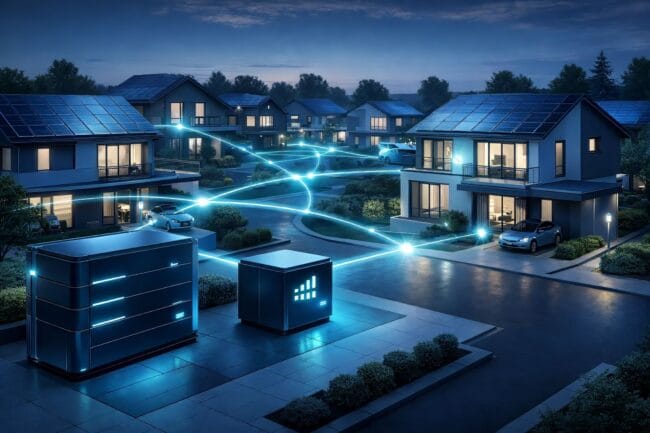
Modular Infrastructure & Neighborhood Resilience
Centralized mega-grids cannot respond rapidly to localized disruptions. Cities now deploy Modular Infrastructure—decentralized, autonomous systems stabilizing districts independently.
Distributed Energy Systems (Virtual Power Plants – VPPs):
- Energy Pooling: Clusters of buildings aggregate local solar generation and battery storage into resilient microgrids.
- Reliability Pricing: Energy is valued by uptime and availability, not just consumption.
- Grid Independence: Neighborhoods maintain critical services even during total municipal grid failure.
VPPs create resilience at the neighborhood scale, reducing systemic risk while ensuring service continuity.

Streets as Programmable Platforms
Urban streets evolve from passive lanes into dynamic, sensor-managed platforms. The curb becomes a high-value, programmable asset integrated with modular infrastructure.
Real-Time Asset Allocation:
- Dynamic Prioritization: Sensors allocate space for electric delivery fleets during morning peaks.
- Adaptive Transformation: Curbs transition into pedestrian zones, green corridors, or commercial spaces by afternoon.
- Algorithmic Optimization: Machine learning continuously adjusts traffic flow, emissions, and pedestrian safety.
Streets+Modular Infrastructure→Real-time Optimization→Reduced Pollution
Air Quality as a Managed SLA
In 2026, air quality functions as a Service Level Agreement (SLA)—a binding contract between the city and its residents.
- Dense Sensor Fabrics: Track pollutants at street and building scales.
- Automated Rerouting: Breaches in safety thresholds trigger immediate traffic adjustments.
- Proactive Protection: Public health operates as a live variable, replacing retrospective reporting.
Air is no longer a static metric; it is a real-time operational asset.
Performance-Based Regulation & The Retrofit Economy
Cities transition from blueprint-driven compliance to outcome-based regulation. Buildings must demonstrate measurable operational performance.
- Automated Penalties: Smart contracts enforce fines based on real-time sensor data.
- Density Bonuses: High-performing buildings earn additional floor-area ratios.
- Institutional Asset Bundling: Retrofit upgrades are packaged into performance-backed financial instruments for investors.
The Retrofit Economy aligns sustainability with economic incentives.

Circular Urban Metabolism
Advanced cities adopt Circular Metabolism, closing loops between energy, mobility, waste, and water. Every output functions as a high-value input for subsequent processes.
Operational Cycle:
- Energy powers electric mobility networks.
- Mobility generates logistical data and organic waste streams.
- Waste converts to biogas and energy via local anaerobic digesters.
- Energy feeds district heating and cooling networks.
- Heat powers water filtration and desalination systems.
- Water recycles into energy and urban cooling infrastructure.
Sustainability becomes the city’s fundamental operating system, not a peripheral add-on.
Strategic Implementation Checklist
- Financial Tracking: Treat emissions and waste as explicit financial variables.
- Decentralization: Shift from centralized utilities to neighborhood-scale modular systems.
- Data-Driven Rules: Apply performance-based permitting tied to measurable real-time outcomes.
- Neighborhood Resilience: Deploy VPPs and local energy storage to ensure service continuity.
- Streets Optimization: Implement programmable curbs and dynamic traffic management.
- Air SLA Monitoring: Establish dense sensor networks and automated mitigation protocols.
- Retrofit Economy: Bundle upgrades into performance-backed financial instruments.
- Circular Operations: Integrate energy, mobility, waste, heat, and water loops into a unified operating system.
