
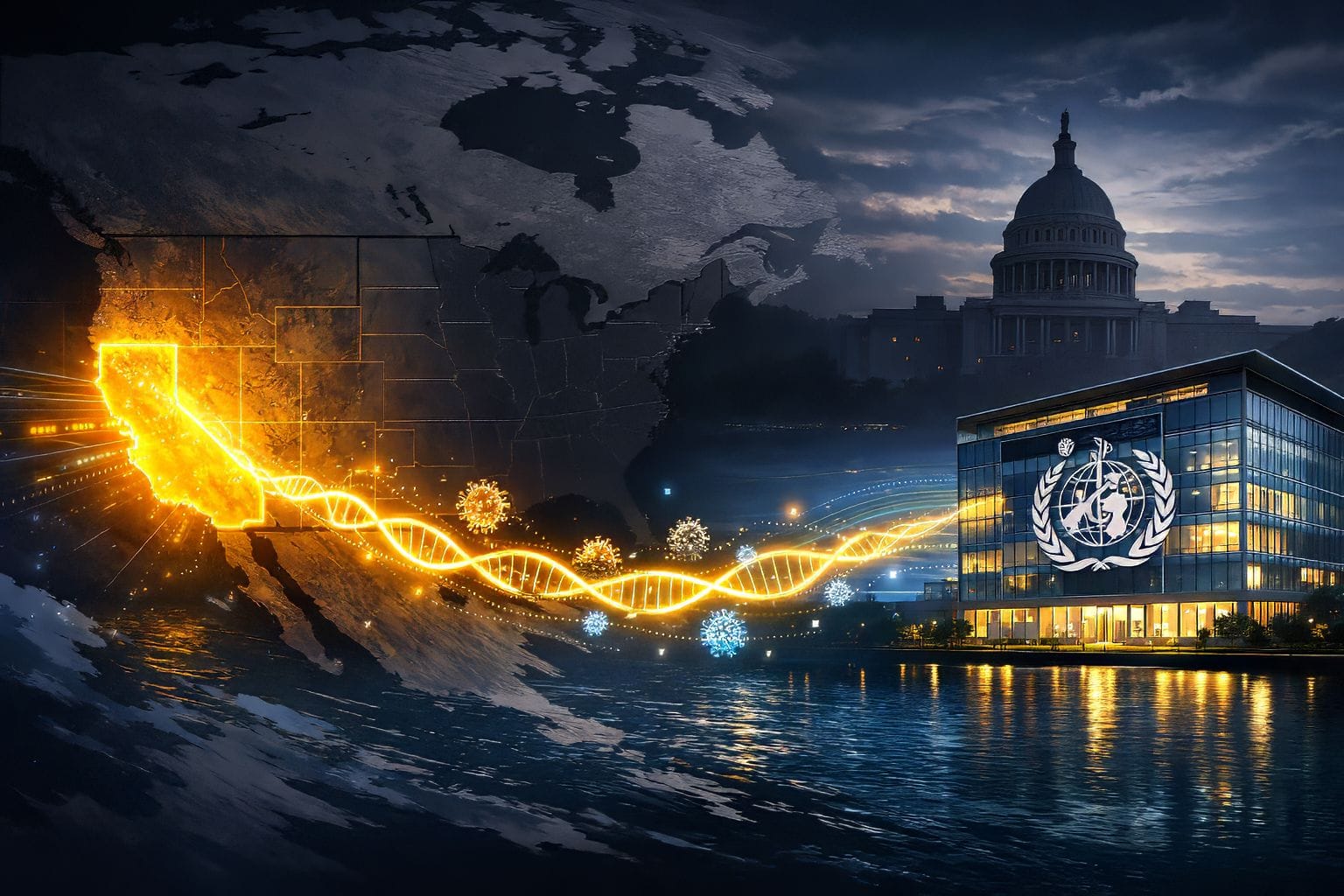
California and the WHO: A New Era of Sub-national Diplomacy
The Precedent That Changed the Rules
January 2026 changed everything. When the U.S. pulled out of the World Health Organization, it left a massive gap in global health. Most people thought it was over. But California had other plans. In just two days, Sacramento went around the federal government to sign its own deal. This partnership between California and the WHO is not just a press release. It is a huge legal experiment. It asks if a single state can actually act like its own country on the world stage.
This is not some dry policy update. By joining the GOARN network, California is testing the U.S. Constitution in a big way. The deal between California and the WHO brings up a tough question. Can a state really protect its own people without Washington’s help? We need to look past the political noise. This is about power and public safety. California and the WHO just showed the world that if you have enough money, you do not need a seat at the UN to start making your own rules in diplomacy.
The Great Exit: Why Washington Walked Out
The United States’ formal exit from the WHO wasn’t just a sudden whim. It was the messy end of a long, bitter fight over power and accountability. People in D.C. were fuming. They argued that the WHO had become a slow, broken machine that needed a total overhaul. To them, it was about national sovereignty. They believed they could protect American interests better by going solo and making their own deals. It wasn’t just some boring policy shift. It was a total, bridge burning exit. But while Washington was busy slamming the door, the rest of the world was left wondering how things would actually work when the next crisis hit the fan.
The Technical Reality
But why does this matter for a single state? Because the WHO isn’t just some ceremonial club where people drink coffee and talk about the weather. It is a massive technical engine. It runs the data platforms that decide which vaccine strains we use every year and how we track outbreaks before they turn into global nightmares. Losing a national seat at that table means losing access to the very systems that keep people safe. Laboratory standards and epidemic intelligence don’t just happen by magic. For many, the federal withdrawal created a massive problem that couldn’t wait for political arguments to settle. You can’t just pause a pandemic while politicians fight in D.C. over who gets to hold the microphone.
California’s Bold Play
California’s response was immediate and loud. They didn’t just disagree. They acted. Sacramento framed the link between California and the WHO as a matter of pure survival. They knew they had to protect public health and their massive economy, so they reached out to Geneva on their own terms. This wasn’t just about science. It was a symbolic middle finger to the federal government.
The partnership between California and the WHO proves that the old lines between foreign policy and local government are blurring. When lives are on the line, California wasn’t content to sit around and wait for Washington to change its mind. They chose to stay on the global map, even if they had to do it alone. It was a clear message: public health is too important to be left to the mercy of a political argument.
GOARN: The Global Health Special Ops
To understand how the link between California and the WHO actually works, you have to look at GOARN. It stands for the Global Outbreak Alert and Response Network, but don’t let the long name fool you. It isn’t some formal political club for world leaders or sovereign states. Instead, think of it as a massive, technical engine powered by the WHO. It brings together the world’s best labs and research centers to track viruses before they spiral out of control. GOARN doesn’t care about D.C. politics. It is an operational network designed to move fast and share data wherever the fire is burning. For over twenty years, they have been the ones on the ground when things get ugly.
Why California Needs a Seat
For Sacramento, joining GOARN isn’t about making a symbolic statement. It is about three very cold, hard facts. First, it is about speed. The partnership between California and the WHO means getting data faster than any slow, back channel political deal ever could. Second, it gives the state a direct line to world class diagnostics and field support through the GOARN network if a new threat emerges. And third, it keeps California’s massive biotech industry aligned with global standards. Without this, the state’s labs would be left in the dark. These aren’t just perks. They are survival tools in a dangerous world.
A Natural Fit
The truth is, GOARN was practically built for this kind of move. The network is already a mosaic of different partners, from top tier universities to local health departments. Adding California to the mix fits perfectly into the existing machine. The mechanics of it are simple, even if the politics are a mess. California has the tools, and the WHO has the platform. The real shocker here isn’t the technical side of the partnership. It is the scale and the sheer nerve of a single state stepping up to play on the global stage. By using GOARN, California is proving that you don’t need a seat in Washington to have a seat at the table in Geneva.
The Legal War: California vs. The Constitution
This is where the story gets really complicated. You can’t just make your own deals with foreign powers and expect Washington to stay quiet. The U.S. Constitution has a very specific rule called the Compact Clause. Its job is simple: stop states from making secret treaties or undercut federal power. Historically, this was a hard line. But lately, things have started to shift. We have seen states make cross-border environmental deals before, and while the federal government hated it, the courts didn’t always shut them down. The big question now is whether the partnership between California and the WHO is a technical handshake or a forbidden treaty.
The Legal Poker Game
California’s lawyers are playing a very smart, very dangerous game. They aren’t calling this a “treaty.” Instead, they are using boring, safe words like “technical memorandum of cooperation.” It is a clever move. By framing this as a matter of “police power” — the state’s duty to keep its citizens healthy and safe — they are trying to stay under the federal radar. Public health has always been a state-level job, after all. But don’t be fooled. Constitutional scholars are already waving red flags. They warn that if other states start following California’s lead, we are headed for a massive legal collision.
The Road to the Supreme Court
It is almost a guarantee that this fight is headed for the Supreme Court. We have seen this movie before. When California tried to make its own climate rules, the federal government didn’t hesitate to sue. The entire case will probably hinge on one single point: is the deal between California and the WHO a binding foreign obligation? If the courts decide it looks too much like a treaty, the whole thing could come crashing down. This isn’t just about some dry legal doctrine anymore. It is about whether a state can actually act on its own when the world starts falling apart. The stakes couldn’t be higher.
The Ground Reality: How It Actually Works
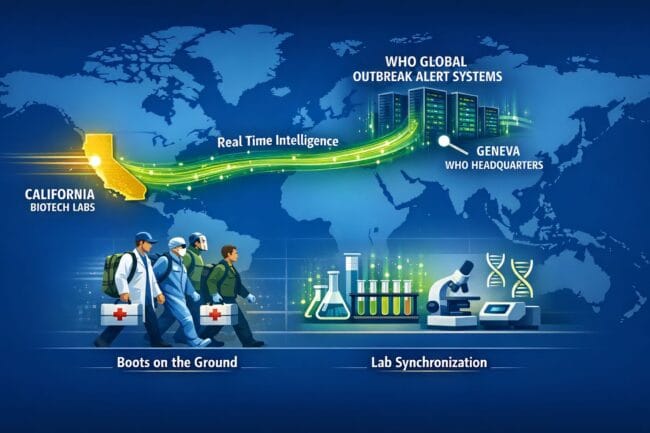
Everything comes down to one simple test. Is this partnership actually useful, or is it just a political show? If the link between California and the WHO delivers real data and expert teams when a crisis hits, it is a win. If not, the political blowback will be brutal. To make this work, the gears have to turn in three very specific ways.
- Real Time Intelligence. This is the big one. California’s labs need to be plugged directly into the WHO’s alert systems. They shouldn’t have to wait for a memo from Washington to know a new variant is spreading. Getting that sequence data immediately means the state can spot an unusual cluster before it turns into a disaster. It is about cutting out the middleman to save time.
- Boots on the Ground. In a real emergency, GOARN can deploy the heavy hitters. We are talking about epidemiologists, virologists, and logistics experts who move fast. If national channels are too slow or stuck in a political gridlock, California can now trigger a request for help on its own. It is like having a direct line to a global emergency response team.
- Lab Synchronization. California is a biotech powerhouse. By aligning its labs with international protocols, the state makes it much easier to run vaccine trials and validate new diagnostics. This isn’t just about science. It is about making sure California’s medical exports and research are ready for the global market without hitting regulatory walls.
The Data Headache
Of course, none of this happens without a fight over the details. Sharing public health data across borders is a legal minefield. Sacramento has to be incredibly careful about privacy and how physical samples are handled. If they don’t get the protocols right, they will run headfirst into federal agencies and private firms. Without clear rules on who sees what, this technical partnership could quickly turn into a legal nightmare. The link between California and the WHO depends entirely on whether they can handle the sensitive stuff without breaking the law.
The Price of Going Rogue
Let’s be real for a second. California isn’t getting a free ride here. Not even close. Joining GOARN is a massive financial gamble, and Sacramento knows exactly what they are signing up for. This isn’t just about some polite handshake or a fancy photo op in Geneva. It is a huge, expensive move that hits the budget where it hurts. The state is going to have to reach deep into its own pockets. They need to pay for membership, build their own response teams from scratch, and hand over their best labs as part of the deal.
Basically, the link between California and the WHO isn’t some clever trick to dodge the costs of global health. It is California deciding to pick up the tab that Washington just walked away from. They are betting that spending big now is way better than watching the whole state economy crash and burn later. It is a high stakes play, plain and simple.
The Money Behind the Move
This whole thing isn’t just about being the “good guy” or saving lives for the sake of science. It is about cold, hard cash. California’s massive biotech scene depends on staying connected to the rest of the planet. For these companies, having access to GOARN and the WHO networks is the secret sauce. It is what gets products approved and global trials running without hitting a wall.
If they lose those direct lines to data, they don’t just lose time. They lose contracts. They lose their edge. For the people running Sacramento, the risk of being left out in the cold was way scarier than the price of going solo. They saw what happens when you get cut off, and they decided to pay whatever it takes to stay in the game. They aren’t waiting for permission anymore.
The Big Gamble: A Nation at Odds
At the end of the day, what we are looking at is a massive, high stakes experiment with no safety net. California isn’t just trying to fix a public health gap. It is trying to rewrite the rules of American power. By doubling down on the link between California and the WHO, Sacramento is sending a loud, clear message to the rest of the country: if the federal government steps back, we step up. They are willing to risk billions and face a constitutional showdown just to keep their seat at the global table.
Whether this move actually works depends on more than just science or smart lawyering. It depends on whether California can survive the incoming fire from D.C. and the massive financial weight of going it alone. One thing is certain. The old way of doing things is dead. The partnership between California and the WHO might be the first crack in a very large dam. If other states decide they are tired of waiting for Washington to lead, we are looking at a total shift in how America interacts with the planet. The world is watching. And for the first time in a long time, they aren’t looking at the White House. They are looking at California.
The Global Stage: Neighbors and Rivals are Watching
The reaction from the rest of the world has been exactly what you would expect: a messy mix of relief and worry. For many international researchers, the link between California and the WHO is a lifeline. They don’t care about the drama in Washington. They just want a partner who knows what they are doing. For them, having a tech-savvy state like California step in is a lot better than watching the whole system fall apart. In places like Europe and Asia, cities and regions have been working directly with the WHO for years. In those halls, California’s move isn’t even that shocking. It is just common sense.
The Fear of a Broken System
But not everyone is cheering. Governments that like to keep a tight grip on things are starting to sweat. They are worried about the precedent this sets. If every state or province starts making its own foreign deals, international diplomacy is going to turn into a circus. Imagine dozens of regional offices all trying to run their own foreign policy at the same time. It would be a nightmare to manage. Right now, the partnership between California and the WHO is just an experiment, not the new normal. But everyone knows that successful experiments usually get copied.
A Template for the Future?
Policy makers in world capitals are keeping their eyes glued to this. They are waiting to see if this actually works. If California manages to stop an outbreak or speed up a vaccine trial without D.C.’s help, you can bet other states will follow suit. But if this leads to a legal train wreck or mixed signals on the world stage, the model will die a quick death. The stakes are massive because this isn’t just about one state. It is about whether the old world of national borders still makes sense in a global crisis.
What Happens When the Next Virus Hits?
The real test for California is going to be about speed. Pure and simple. When a new outbreak starts, legal arguments won’t save anyone. Seconds will. If being part of the GOARN network lets Sacramento see the threat even a few days before Washington, then lives get saved. We already learned this the hard way. A few days of delay can turn a small problem into a total disaster. The link between California and the WHO has to cut through the red tape, or it is useless.
But there is a massive catch. If this deal just creates more confusion, it could backfire. Imagine a situation where the state follows one set of WHO rules and the federal government demands something else. That is how you get a slow, broken response. People on the ground won’t know who to listen to. The next pandemic is going to show us exactly what this experiment is worth. Either this sub-national setup makes us faster, or it just adds more noise to a crisis. We are going to find out soon enough.
Fixing the System: A No-Nonsense Roadmap
If we are going to take the California experiment seriously, we have to stop treating it like a political sideshow and start looking at the plumbing. The legal fog is the first thing that needs to go. Congress has been sitting on its hands for too long. They need to quit the stalling and actually pass a framework that defines how states can jump into these global networks. It is about creating a predictable playbook so we aren’t constantly ending up in court. This moves the whole thing from a random gamble to a solid, lawful policy.
But the law is only one part of the headache. The technical side is where things usually fall apart. We need the WHO, the state labs, and the federal agencies to get in a room and hammer out the rules for data and specimen transfers before the next disaster hits. If they aren’t speaking the same technical language, the friction will kill any chance of a fast response. The same goes for how we talk to the public. If Washington and Sacramento are shouting different instructions, people will just stop listening. Trust is easy to break and nearly impossible to fix during a crisis.
At the end of the day, a fancy seat at the GOARN table is worthless if the labs back home are falling apart. We need real, sustained cash for local surveillance and infrastructure. The partnership between California and the WHO should be judged by cold, hard results. Are we seeing faster data? Are the response times actually dropping? If this is truly about keeping people safe, then the outcomes have to matter more than the political points.
The Big Gamble: A World Without Borders
California is basically trying to do the impossible. They are trying to balance two clashing realities that don’t want to play nice. On one hand, you have viruses that don’t care about maps or borders. On the other, you have a constitutional system that says only Washington gets to talk to the rest of the world. The deal between California and the WHO is sitting right in the middle of that explosion. It is a bold, messy, and high stakes attempt to rewrite the rules of the game.
If this works, everything changes. If California gets those early warnings and saves lives while the feds are still figuring things out, other states will follow their lead in a heartbeat. It becomes the new playbook for a fractured world. But if it leads to a legal train wreck and more confusion, it will just be remembered as a warning of what happens when states overreach. There is no middle ground here.
Either way, we can’t just ignore this as some weird regional experiment. This isn’t just about Sacramento. It is about the next decade of how the planet actually functions. Are we moving to a system where cities and regions become their own international players? The stakes aren’t just about politics or paperwork. They are measured in the speed of the next response and the lives saved or lost when the next siren starts. The world is watching. And this time, they aren’t looking at D.C. for the answers.
FAQ: California and the WHO
Q: Why did California decide to partner directly with the WHO?
A: It is pretty simple. After the U.S. walked away from the WHO in January 2026, California didn’t want to be left in the dark. They acted fast to keep their access to global health data and research networks. It was a move to protect their people and keep their massive biotech industry from losing its edge.
Q: What exactly is GOARN and how does it help?
A: Think of GOARN as a global “neighborhood watch” for viruses. It is a network of labs and experts that helps catch outbreaks early. By joining, California gets real-time data and expert help on the ground without needing to be an official “member state” of the WHO.
Q: Is this whole thing even legal under the Constitution?
A: That is the big debate right now. Some say states can’t make their own foreign deals because of the Compact Clause. California says it is just a technical partnership for public health, not a treaty. This is likely headed for a showdown in the Supreme Court.
Q: What does California actually get out of this deal?
A: Faster signals and better science. They get a direct line to global virus alerts and can bring in international experts if things get ugly. It also means their hospitals and tech companies can keep working with the rest of the world without waiting for Washington to catch up.
Q: What are the biggest risks of this approach?
A: Confusion and cost. If every state starts doing its own thing, U.S. foreign policy could turn into a mess. There is also the question of money. Critics are asking why state taxpayers should pick up the tab for international programs that used to be a federal job.
Q: How is the rest of the world reacting to California’s move?
A: Most are welcoming it but with a bit of caution. Scientists are happy to have a stable partner like California back in the game. But some governments worry it sets a precedent that could make global diplomacy a lot more complicated in the future.
Q: Will this actually make a difference in the next pandemic?
A: That is the ultimate test. If California catches a threat early and saves lives, it becomes the new gold standard for how states can lead. If it just leads to legal fights and mixed messages, it will be remembered as a failed experiment. We will find out when the next crisis hits.
Editorial Disclaimer
This analysis, titled California and the WHO: A New Era of Sub-national Diplomacy, is built on current reporting, official state records, and expert insights into the GOARN partnership. Our goal is to break down a complex political shift, but this text should not be treated as formal legal advice or a public health mandate.
The relationship between Sacramento and Geneva is a moving target. Laws and international protocols can shift fast, so we recommend checking official policy updates for the latest changes. The views shared here are our own professional perspective. They do not represent the official stance of the State of California, the World Health Organization, or any federal agency.
References
- Governor Newsom’s Official Announcement: The formal press release detailing California’s historic move to join the WHO-coordinated international network via Office of Governor Gavin Newsom.
- International Health Network Coverage: Analysis of California’s strategic decision to maintain ties with UN health networks and its implications for global disease response via Reuters.
- Global Outbreak Alert and Response Network (GOARN): The official homepage of the WHO network that manages rapid detection and response to global health emergencies via WHO GOARN.
- Strategic Shift in Public Health: An overview of how California is positioning itself as a global health leader by bypassing federal withdrawals to ensure pandemic preparedness via NBC Bay Area.
