

Marcel LeBrun’s heroic 99-home gift for Canada’s homeless
Most entrepreneurs, after cashing in multi-million dollar exits, celebrate with yachts, luxury cars, or sprawling estates. Marcel LeBrun chose a different path. For him, success is measured not in possessions, but in impact. Instead of spending on luxury, he invested in a community. He built 99 tiny homes in Fredericton, New Brunswick, giving people a chance to move from homelessness to stability, purpose, and dignity.
These homes are carefully designed to provide more than shelter. They offer privacy, safety, and a sense of belonging. Kitchens allow residents to prepare meals for themselves or their families. Bathrooms provide security and personal space. Living areas are bright and welcoming, creating a real home environment. But the homes are only part of the solution. Each is connected to employment opportunities, social enterprises such as Neighbourly Coffee, and wrap-around support services including mental health care and skill-building programs. Residents gain the tools they need to rebuild their lives and regain confidence.
The organization behind this initiative, 12 Neighbours Community Inc., has become a model of innovation in social housing. It demonstrates how combining housing, employment, and comprehensive support can tackle homelessness effectively. The project recognizes that homelessness is rarely just about the lack of a roof. It often involves trauma, lost skills, and disconnection. By addressing all these factors together, 12 Neighbours helps residents regain independence, contribute to the community, and envision a future they thought was out of reach.
Residents are not passive recipients of aid. Many work within the community, learning practical skills, earning income, and building confidence. Neighbourly Coffee is central to this effort. Every cup sold supports the community and gives residents an opportunity to develop skills and pride in their work. Employment in the community is not charity; it is empowerment. It gives residents a sense of purpose and the ability to actively participate in building their future.
The impact of 12 Neighbours goes beyond Fredericton. The project shows that homelessness is not an unsolvable problem but a challenge that can be addressed with creativity, resources, and commitment. Marcel LeBrun’s approach demonstrates that true success is measured not by luxury, but by lives transformed and communities strengthened. His work provides a blueprint for other cities, showing how targeted, human-centered investment can create lasting, meaningful change.
12 Neighbours Community: Where Homes Build Futures
Marcel LeBrun made a name for himself in technology, but his ambition never centered on luxury or personal gain. After achieving success with Radian6, he turned his attention to one of society’s toughest problems: homelessness. Instead of acquiring possessions, he invested in people, envisioning a community where a stable home is the first step toward rebuilding a life.
In Fredericton, New Brunswick, nearly 96 tiny homes have been completed, each around 23 square meters. These are not just shelters; they are thoughtfully crafted spaces designed to restore dignity. Each home includes a kitchen, a bathroom, a living area, and a porch. The design is simple but intentional, offering residents privacy, safety, and a place to feel truly at home. Unlike temporary shelters, these homes provide stability, allowing residents to focus on personal growth, skill development, and participation in community life.
Housing alone, however, is not the solution. 12 Neighbours combines living spaces with employment opportunities, training programs, and social enterprise initiatives. Residents can work at ventures such as Neighbourly Coffee, where they gain real skills, earn income, and take pride in contributing to their community. Support services for mental health, addiction recovery, and life skills are embedded into daily routines, creating a holistic network that nurtures both practical needs and personal empowerment.
The impact of 12 Neighbours goes beyond bricks and mortar. By linking housing with purposeful work and comprehensive support, the community helps people regain independence and confidence. Marcel LeBrun’s model illustrates that homelessness is not an insurmountable problem but a challenge that can be addressed when solutions focus on humans first. This approach provides a roadmap for communities worldwide, showing that investing in people and structured opportunities can transform lives and create lasting, meaningful change.
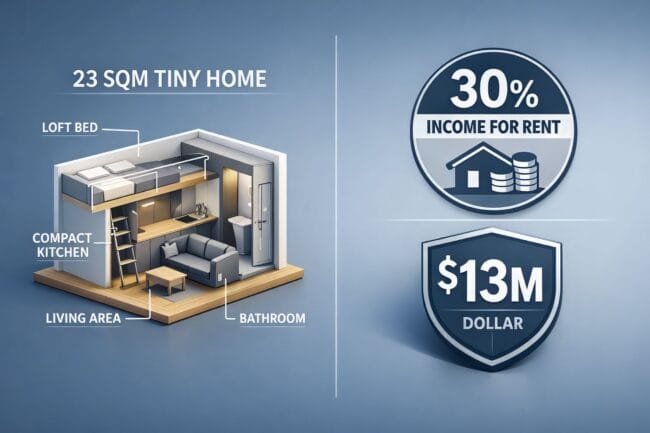
Power of Numbers: 12 Neighbours in Perspective
The story of 12 Neighbours begins with a carefully considered financial strategy. The initiative benefits from thirteen million dollars in public and private support, a major endorsement that has allowed the community to expand steadily toward ninety-nine homes. This investment is not simply funding; it represents a societal validation of an approach that prioritizes stability and measurable opportunity. Alongside this, residents contribute a maximum of thirty percent of their personal income toward housing, a calculated buffer that neutralizes the immediate pressures of survival and frees cognitive bandwidth for work, education, and participation in community programs. In Fredericton, this combination of financial architecture and institutional confidence forms the backbone of the project’s approach.
Within this framework, the homes themselves assume a new role. Each dwelling occupies a compact living footprint designed for maximum autonomy, with interiors structured to provide privacy, functional living areas, and small porches that encourage reflection and social interaction. These spaces do more than house; they anchor routines and facilitate independence, giving residents a controlled environment in which to experiment with stability and personal development. The size of each unit is intentional, a deliberate balance between efficiency and psychological comfort.
Beyond architecture, the initiative’s social dimension reinforces its impact. Residents have access to employment programs and community-run enterprises, where engagement is both practical and validating. By participating in these structured activities, individuals consolidate skills, generate income, and reaffirm their role as contributors to the broader neighborhood. Each program is designed to sustain progress, not as a temporary intervention but as part of an integrated ecosystem that combines housing, work, and social support.
The interplay between finance, physical space, and social opportunity demonstrates a subtle but powerful dynamic. The thirteen million dollars in funding validates the model in the eyes of both government and private partners, signaling confidence in its efficacy. The thirty percent housing contribution functions as a lever, ensuring that residents can allocate energy to long-term goals rather than immediate survival. Each compact home, thoughtfully designed for autonomy, provides the necessary platform to operationalize these ambitions. Together, these elements do more than coexist; they interact to produce measurable effects on the residents’ capacity to engage, learn, and maintain stability.
Through this lens, numbers acquire a human dimension. Each dollar invested sustains a program, each percentage point of rent calculated provides mental space, and each small home validates the premise that structure, autonomy, and opportunity can coexist to create meaningful continuity. The Fredericton project demonstrates that interventions rooted in careful planning, financial foresight, and social integration can produce enduring effects, showing that strategic design and targeted support can neutralize the pressures of insecurity while sustaining human potential.
Housing First, Opportunity Always
At the heart of 12 Neighbours lies a philosophy that prioritizes secure, permanent housing as the starting point for meaningful social engagement. For residents, a stable home is not merely a roof over their heads; it anchors daily routines, provides a sense of predictability, and creates the mental space necessary to consider the future beyond immediate survival.
Marcel LeBrun’s approach extends beyond the foundational shelter, embedding opportunities for economic participation and personal development directly into the community. Structured pathways for employment and skills acquisition allow residents to engage in work that is both practical and validating, transforming daily activity into tangible achievements. Support for mental health and addiction recovery is seamlessly integrated, ensuring that personal well-being is addressed in tandem with occupational and educational growth.
The community’s social enterprise initiatives offer an additional layer of engagement. Programs such as Neighbourly Coffee provide residents with hands-on experience, enabling them to contribute actively to the neighborhood while acquiring skills that extend into broader employment opportunities. Through these combined supports, residents gain not only stability but also agency, gradually reclaiming confidence and autonomy.
By embedding opportunity directly alongside permanent housing, 12 Neighbours demonstrates that social progress does not emerge solely from shelter itself. It is facilitated through structured participation, care, and the chance to contribute to a shared community. In this integrated environment, residents are empowered to establish independence, nurture personal growth, and cultivate a sense of belonging that resonates far beyond the confines of their individual homes.

Neighbourly Coffee: Brewing Opportunity
Within the 12 Neighbours community, the café known as Neighbourly Coffee functions as more than a place to grab a drink. It is a living laboratory where housing, work, and personal development intersect. Staffed primarily by residents, the café provides structured opportunities to gain experience in customer service, operational management, and day-to-day business functions, all within a supportive environment.
Each cup served carries more than caffeine; it carries the resources to sustain programs that underpin the community. Revenue generated flows back into initiatives that facilitate employment, skills training, and social support, ensuring that every interaction contributes to a broader network of opportunity. Residents gain practical competencies while engaging directly with the Fredericton public, forging connections that reinforce both community cohesion and individual confidence.
A coordinator at the café emphasizes its dual purpose: “Neighbourly Coffee is more than a café. Every cup funds opportunity.” This ethos underscores the intentional design of 12 Neighbours as a community where economic participation is embedded into daily life. Through this enterprise, residents are able to anchor themselves in meaningful work, acquire transferable skills, and witness the tangible outcomes of their contributions.
Neighbourly Coffee demonstrates that integrating social enterprise into residential communities can generate measurable impact. Housing provides stability, employment offers agency, and enterprises like the café create spaces where purpose and participation converge. The initiative exemplifies how carefully structured opportunities can transform routine activity into instruments of growth, engagement, and community resilience.
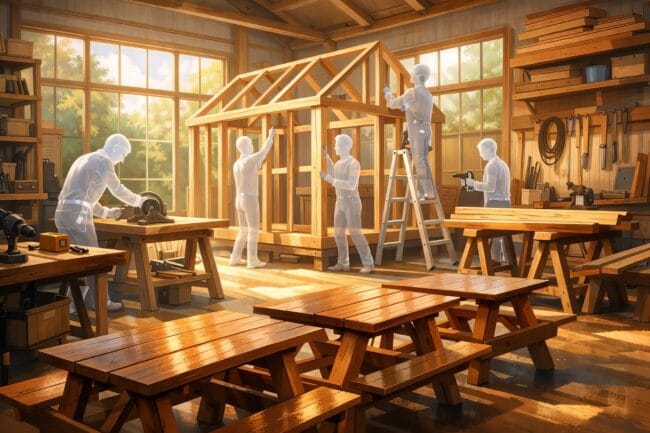
Beyond Coffee: A Micro-Industrial Ecosystem
At 12 Neighbours, the community operates as a self-contained micro-industrial ecosystem, where every workshop and workspace serves a dual purpose: production and personal agency. The heartbeat of this system is the tiny home workshop, where residents participate in the construction of their own dwellings. Here, they are not merely building houses; they are orchestrating tangible progress, solidifying routines, and manifesting industrial dignity. Each nail driven and wall assembled is a concrete assertion of control, a hands-on exercise in designing both space and future.
From the workshop, activity flows into artisanal production. Residents contribute to market-ready products, from picnic tables to handcrafted goods, transforming raw materials into items that bridge the gap between the village and Fredericton’s wider economy. This is not hobby work. It is purposeful engagement that links craft to commerce, embedding the value of labor directly into the neighborhood’s social fabric. Every table, every product, functions as a node in a system where personal skill translates into economic participation, reinforcing both confidence and competence.
The ecosystem extends further into small-scale business operations, including printing and retail initiatives. Residents navigate real-world logistical challenges, customer interactions, and operational decision-making, cultivating vocational versatility and operational fluency that extend well beyond the confines of the community. These activities transform everyday labor into measurable impact, demonstrating that economic literacy and practical engagement can coexist within a residential setting.
In this environment, 12 Neighbours illustrates a subtle but powerful principle. Structured, productive work anchored by housing stability can serve as both a livelihood and a laboratory for independence. Residents emerge as architects of their own recovery, solidifying capabilities, manifesting discipline, and contributing to a cohesive ecosystem where personal growth and economic participation are inseparable. The neighborhood is not simply a collection of homes. It is a living industrial narrative, where labor, skill, and enterprise intersect to create durable social and economic foundations.

Internal Infrastructure: Fortifying the Human Habitat
A house is merely a physical shell until the internal architecture of the human occupant is supported. At 12 Neighbours, this principle guides every layer of the community’s approach. Mental health services and substance use counseling function as structural reinforcement, fortifying residents’ psychological foundation and ensuring that the stability of the home extends inward to the mind and emotions.
Educational initiatives and vocational training are integrated as scaffolding, providing residents with operational tools and adaptive strategies that strengthen their ability to navigate daily challenges. These programs are not abstract enrichment; they act as internal beams that maintain balance and coherence within each individual’s life, calibrating their capacity to engage, contribute, and sustain themselves within the wider community.
Case management takes the form of navigational charting, mapping trajectories for personal growth and recovery in a deliberate, data-informed way. It enables residents to assess their progress, adjust plans, and anticipate obstacles with a clarity that mirrors architectural planning. Within this framework, resilience emerges naturally as a calculated byproduct of a secure environment, rather than a trait imposed or artificially encouraged.
By viewing support as integral infrastructure rather than optional assistance, 12 Neighbours positions each resident as an active architect of their own stability. The community demonstrates that permanent housing combined with coordinated internal fortification allows individuals not merely to survive but to operate with agency, adaptability, and a grounded sense of continuity. In this model, the interplay between physical shelter and mental infrastructure illustrates how thoughtful design, both structural and social, can create durable, self-sustaining outcomes.
From Vision to Reality: Completion Milestones
By April 2024, 96 homes had been completed within the Fredericton community. Each dwelling stands as a tangible marker of security and permanence for individuals who once navigated life without stability. These are not just houses; they are spaces where routines, autonomy, and opportunity intersect, providing residents with a foundation from which to engage with the world in a structured and confident way.
Marcel LeBrun reflected on the journey from concept to completion, noting that the project has evolved far beyond its initial blueprint. “What began as a rough plot of land and an idea has become a thriving community. People now have a place to call home and the chance to rebuild their lives,” he said. His statement underscores the intentionality behind the design, highlighting that each completed unit is more than a physical structure. It is a carefully orchestrated environment where housing, employment, and personal development converge to create sustainable change.
The milestone of 96 completed homes also signals the nearing fulfillment of the community’s ultimate goal of 99 units. Each new home added to the neighborhood strengthens the network of social and economic supports, reinforcing the philosophy that permanent shelter must be accompanied by opportunities for engagement, work, and personal growth. In this way, 12 Neighbours exemplifies how visionary planning and meticulous execution can convert abstract ambition into measurable, lived reality.
Early Outcomes: Stability, Skill, and Purpose
Early indicators suggest that the 12 Neighbours model is producing measurable and sustained effects within the Fredericton community. Residents are experiencing a new level of stability that goes beyond simply having a roof overhead. The secure housing allows people to plan routines, pursue personal development, and engage with their neighbors without the constant pressure of precarious living.
Employment initiatives, including Neighbourly Coffee and on-site workshops, have created structured opportunities for residents to gain practical skills and operational experience. These activities function as both professional training and personal reinforcement, helping individuals anchor themselves in productive roles while contributing meaningfully to the community. The combination of work and living arrangements transforms ordinary labor into a structured system of personal and economic agency.
Social integration has also strengthened as residents engage with the broader Fredericton public through community events and enterprise operations. These connections are not incidental; they are deliberately cultivated to embed residents within a larger social and economic network, ensuring that the benefits of housing and employment extend beyond the immediate confines of the neighborhood.
Collectively, these outcomes demonstrate that stable housing paired with intentional employment and comprehensive supports generates a durable environment where independence, competence, and a sense of purpose naturally emerge. The model illustrates that carefully designed programs can produce ripple effects, reinforcing personal stability while simultaneously strengthening the wider community.
Spreading the Model: The Ripple Effect
The impact of 12 Neighbours is extending beyond Fredericton. Inspired by the community’s approach, Saint John, New Brunswick is developing the Sunnyside Tiny Home Community, a project modeled closely on the Fredericton experience. This replication demonstrates that solutions grounded in thoughtful design, stable housing, and integrated opportunity can travel beyond a single location and adapt to other urban contexts.
The Fredericton project illustrates that homelessness is not an intractable problem but a consequence of structural gaps in social systems. When carefully targeted philanthropy and strategic planning intersect, communities can create environments that neutralize instability and enable residents to regain control over their economic and social lives.
The global relevance of this model lies in its adaptability. By combining housing-first principles with pathways for employment, enterprise, and personal development, communities around the world can observe how stability, skill, and engagement reinforce one another. The ripple effect is clear: a project designed with precision and empathy can serve as a blueprint for cities seeking durable, scalable approaches to housing insecurity.
A Framework for Human-Centred Change
The experience of 12 Neighbours reveals that addressing housing insecurity requires more than simply providing shelter. Permanent housing functions as the foundation upon which residents can engage with broader opportunities, allowing potential to emerge in ways that temporary solutions rarely permit.
Equally important is the integration of comprehensive supports that confront the underlying challenges individuals face. Mental health services, substance use counseling, and educational initiatives act as structural reinforcements, ensuring that residents can navigate personal obstacles while consolidating stability. Employment opportunities and social enterprise projects such as Neighbourly Coffee create practical avenues for residents to apply skills, contribute economically, and cultivate a sense of purpose.
Community integration amplifies these effects. By connecting residents to the wider Fredericton population through programs, events, and collaborative initiatives, the project fosters a sense of dignity and belonging. These social connections are not peripheral but central, solidifying the psychological and civic infrastructure that supports long-term well-being.
The project’s collaboration with government bodies and private partners demonstrates that scalable interventions are achievable when funding and strategic planning converge. Institutional backing enables the expansion of both housing and supportive programs, validating the model and ensuring its sustainability.
By combining permanent housing, holistic supports, purposeful work, and community integration, 12 Neighbours reframes housing from a mere commodity into a platform for structured social change. It offers a replicable example of how thoughtful, human-centred design can convert shelter into opportunity, stability, and meaningful engagement.
A Model of Enduring Impact
The 12 Neighbours initiative led by Marcel LeBrun demonstrates that carefully directed philanthropy, paired with deliberate planning and integrated social enterprise, can produce measurable and lasting change for people experiencing homelessness.
The community’s 96 completed tiny homes do more than provide shelter; they anchor a system in which residents can access meaningful employment, develop practical skills, and engage in community life. Enterprises such as Neighbourly Coffee exemplify how economic participation is woven into daily life, offering both income and a sense of purpose while strengthening social bonds within the neighborhood.
By prioritizing investment in human potential alongside physical infrastructure, 12 Neighbours moves beyond temporary interventions. The project provides a structured environment where independence, competence, and stability are attainable, demonstrating that housing insecurity is not an inevitable condition but a challenge that can be addressed systematically.
In a social landscape where homelessness is often perceived as a chronic and unsolvable problem, the Fredericton model offers a concrete example of what is possible when housing, opportunity, and support are thoughtfully aligned. It stands as a replicable template for other communities seeking to convert targeted resources into sustained empowerment, dignity, and communal resilience.
FAQ: Marcel LeBrun’s 99-Home Initiative
Q: What is the 12 Neighbours project?
A: 12 Neighbours is a non-profit community in Fredericton, New Brunswick, founded by Marcel LeBrun. It provides permanent, affordable tiny homes alongside employment opportunities, social enterprise programs like Neighbourly Coffee, and comprehensive wrap-around supports for residents who have experienced homelessness.
Q: How many homes are part of the project?
A: The initiative has completed 96 homes, with a goal of 99. Each home is compact but thoughtfully designed to provide privacy, comfort, and security, serving as a stable foundation for residents’ personal and professional development.
Q: How is housing made affordable for residents?
A: Residents pay no more than 30 percent of their income in rent. This calculated financial buffer allows individuals to focus on skill-building, employment, and community engagement without the constant stress of financial instability.
Q: What role do social enterprises play in the community?
A: Social enterprises, such as Neighbourly Coffee and on-site workshops, provide residents with meaningful employment, practical skills, and income. These programs integrate work into daily life, fostering economic independence and a sense of purpose.
Q: How is the project funded?
A: The initiative has received $13 million in government and institutional support. This major public-private endorsement allows for expansion, program development, and long-term sustainability of the community.
Q: Can this model be replicated elsewhere?
A: Yes. Inspired by Fredericton, similar projects are emerging in other Canadian cities, including Saint John. The model demonstrates that combining permanent housing, employment, and social support can create scalable, sustainable solutions to homelessness.
Editorial Disclaimer
This article, Marcel LeBrun’s heroic 99-home gift for Canada’s homeless, is based on publicly available information, verified reports, and interviews with sources connected to the 12 Neighbours Community in Fredericton. While every effort has been made to ensure accuracy, the narrative reflects editorial interpretation and analysis designed to provide context, insight, and a solution-focused perspective. The article is intended for informational and journalistic purposes and should not be considered a substitute for official statements from Marcel LeBrun, 12 Neighbours Community Inc., or related organizations.
References
- Building a Community with Marcel LeBrun: An in-depth look at the vision behind the project, founded by tech entrepreneur Marcel LeBrun to address chronic homelessness through a dignifying housing-first approach via University of New Brunswick (UNB).
- Fredericton’s 12 Neighbours Community Expansion: A report on the progress of the tiny home village, detailing the social enterprise center and how the community integrates housing with employment opportunities via Yahoo News Canada.
- City of Saint John Housing for All Strategy: An official municipal announcement regarding the partnership with 12 Neighbours to implement “Green Zone” designations for tiny home developments via the City of Saint John.
- 12 Neighbours Inc. Official Site: The primary resource for the community’s mission, values, and the “three pillars” of their model: Dignity, Community, and Opportunity via 12 Neighbours.
- Project Overview and History: A summarized history of the organization’s development from a pilot project to a leading example of modular social housing in Canada via Wikipedia.
