

How Tennis Rankings Really Work: A Complete Guide
How Tennis Rankings Really Work is a question every tennis fan eventually asks. How can a player win a tournament and still drop in the rankings? Tennis rankings are less about wins and losses and more like a mathematical puzzle, tracking performance across a Rolling 52-week system. They do not measure talent. They measure efficiency, timing, and consistency.
ATP and WTA rankings are not a measure of pure skill. They are a performance ledger. They do not show who hits the ball the hardest. They show who maintained peak form at the most critical moments of the season. Understanding this distinction is key to following the drama of professional tennis.
Rankings track results where it counts most, not hypothetical matchups. The pressure to defend points, perform at the biggest tournaments, and maintain consistency is what separates champions from the rest of the field.
The 52-Week Cycle
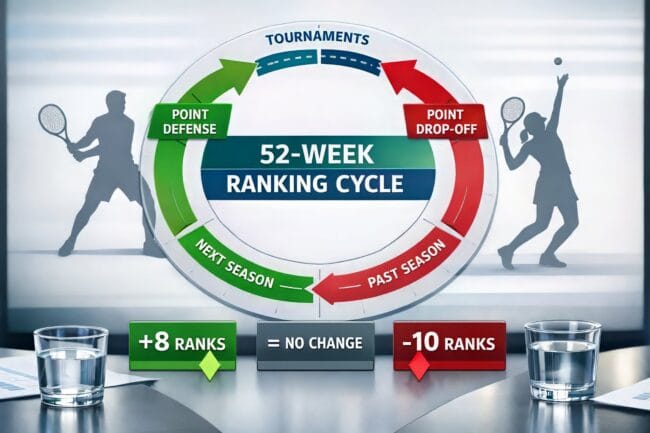
Tennis rankings operate on a Rolling 52-week system, where every point a player earns is temporary. In professional tennis, you do not own points, you rent them for a year. When the same tournament returns the following season, last year’s points drop off. This process, known as drop-off, is merciless.
Consider a player who won Wimbledon last year, earning 2,000 points, but loses in the first round this year. In just one week, they could tumble 10 to 15 spots in the rankings. This is the intense pressure of defending points, which explains why even the most consistent performers must maintain peak form throughout the season.
The system does not forgive complacency. Points earned at smaller tournaments or from previous deep runs vanish if they are not defended. Success in tennis is not about isolated victories; it is about sustaining results where they matter most, at the tournaments that carry the most weight on the leaderboard.

The Hierarchy of Points
Not all tournaments are created equal. The ATP and WTA assign points based on tournament category. Here’s a clear breakdown to make it easier to understand and compare at a glance:
Points by Tournament Category
| Tournament Type | Winner | Finalist | Semi-Finalist |
|---|---|---|---|
| Grand Slam | 2,000 | 1,200 | 720 |
| Masters 1000 / WTA 1000 | 1,000 | 600 | 360 |
| ATP/WTA 500 | 500 | 300 | 180 |
| ATP/WTA 250 | 250 | 150 | 90 |
Note: Points shown reflect the ATP system. While the Grand Slam structure is universal, WTA point distributions for other categories (1000, 500, 250) may vary slightly.
A quarterfinal appearance at a Grand Slam can be worth more than winning an ATP 250 event. Scheduling and peaking at the right tournaments is crucial. Success is not just about winning matches—it is about winning them where it matters most.
Defending Points: The Heart of the Rankings
Defending points is the most pressure-filled part of professional tennis. Champions face it like clockwork every year. Missing a deep run from the previous season can erase months of work in a single week.
Consider a top-10 player who reached the semifinals at a Masters 1000 event one year but exits in the second round the next. They may lose hundreds of points and drop several ranking spots within days. For example, winning an ATP 250 tournament might earn 250 points, but if the same player loses 600 points from a previous Masters 1000 performance they are defending, their net point total decreases, and they can fall in the rankings despite a victory. Fans call this “ranking volatility,” but for players, it is high-stakes pressure, the relentless expectation to replicate past performances.
Top professionals carefully plan their schedules around this reality. Choosing which tournaments to play is not just about chasing titles; it is also about strategically defending points while managing physical and mental fatigue. In tennis, a single missed point can reshape a season, and defending past results is what separates consistent champions from fleeting contenders.
The Race vs The Rankings
There is an important nuance that many casual fans miss. The Rankings are based on the Rolling 52-week system and determine tournament seedings. They structure the draws so that top-ranked players avoid facing each other in the early rounds.
The Race, on the other hand, starts from zero every January and tracks points earned during the current calendar year. It decides who qualifies for the season-ending Finals. A player can drop in the official Rankings due to points lost from the previous year, yet still lead The Race with strong performances in the current season.
Understanding this distinction explains why a player may climb The Race leaderboard while temporarily falling in the Rankings. For insiders, this difference is crucial when analyzing season-long performance versus historical consistency.
High rankings are not just a matter of prestige, they are a career-defining privilege. Being seeded in tournaments ensures that a player avoids facing the very best opponents, such as Djokovic or Alcaraz, in the early rounds. Lower-ranked players do not have this advantage, which makes their path to deep runs significantly harder.
Seedings protect consistent performers and allow them to plan their season strategically. In a sport often decided by just a few critical points per match, this privilege can have a tangible impact on a player’s career trajectory, influencing who reaches the latter stages of tournaments and who falls short.
The Injury Trap
Rankings are unforgiving to injured players. Even legends feel it. Take Rafael Nadal’s struggles during the 2023–24 season. Missing a major tournament means not defending thousands of points, regardless of past dominance. Injuries do not pause the ranking system; the clock keeps ticking.
A player returning from injury may have the ability to beat top opponents but enters tournaments with a ranking far below their actual level. They must climb back point by point, often facing tougher draws due to their temporarily lower position.
One exception exists: Protected Ranking (PR). This allows injured players to enter tournaments based on their pre-injury ranking, though it does not provide seedings. PR is the only built-in concession the system offers, giving top players a lifeline without compromising the fairness of draws.
Perspective
Tennis rankings are a ledger, not a ruler of greatness. They reward consistency, timing, and strategic peak performance. They are cold, precise, and occasionally dramatic. They do not measure talent, potential, or who would win in a hypothetical match tomorrow.
Once you understand Points Defending, the Rolling 52-week system, the hierarchy of tournament points, The Race versus The Rankings, and the nuances of Protected Rankings, the system becomes far less mysterious. Rankings stop being an argument about who is the best and start serving as a record of who delivered results when it mattered most.
References
- Official Ranking Protocols: Explore the comprehensive point distribution and professional standards in the official ATP Tour Rulebook.
- Real-Time Performance Tracking: Follow the live point fluctuations and the “Race to Turin” standings in real-time at Live Tennis.
